When it comes to making adjustments, I often notice that people try to make their environment and situation as autism-friendly as possible. It’s definitely a good thing when this happens. For me, it’s always extra motivation to do my best when I see that sensitivities are being considered, even though I may not always be equally affected by everything, everywhere.
I particularly appreciate it when people think broadly without specifically naming certain groups, thus avoiding unintentional stigmatization. I prefer not to hear things like ‘we turned off the radio for autistic people’, because there are autistic individuals who enjoy music, just as there are non-autistic people who might prefer not to hear the same song repeatedly.
Some organizations or hosts forget that stress isn’t limited to the moment itself. They might think certain adjustments are obvious, but this can also reflect a limited ability to think and communicate effectively.
When I talk about this in public, I often get asked, ‘where do we draw the line?’ and ‘should we do everything for autistic people?’. I believe the line is drawn at whether the person feels welcome or not, and whether the organization can still welcome them with the requested adjustments.
Regarding the second question, I think as much should be done for non-autistic people as for autistic people. A good start is being aware of the adjustments made to welcome certain people or groups. If the same is done from an autistic perspective, I believe we’re reaching the limits of what’s reasonable.
I often feel tired after an activity or meeting because I have to think so much beforehand and then process many thoughts afterwards.
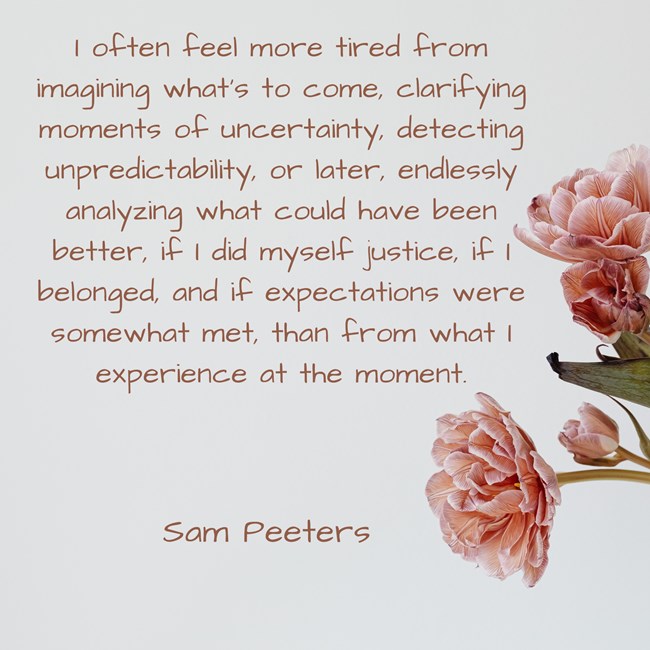
This is what I mean when I tell people: “I often feel more tired from imagining what’s to come, clarifying moments of uncertainty, detecting unpredictability, or later, endlessly analyzing what could have been better, if I did myself justice, if I belonged, and if expectations were somewhat met, than from what I experience at the moment.”
I notice that people sometimes forget what goes on in my head before and after an event. I often feel exhausted trying to envision what will happen, what to expect, who will be there, how to get there safely, and then how to get home safely and what happens next.
Fortunately, there are good examples of people and organizations that are aware of this and ask afterwards if everything went well, and in the case of personal meetings, if I got home safely and what they could consider in the future.
This isn’t just about my autistic thinking; I believe it can be positive for many other people too. The more I have to research, think, plan, and organize to go somewhere or meet someone, before or after, the less likely I (and others) will be to be pleasant, social, friendly, empathetic, and cooperative in the moment. If people then see me as ‘autistic’ or ‘unfriendly’, it has more to do with the overwhelming confusion in my head from having to imagine everything to get there, rather than the degree of my autism.

 The European Autist