
Autism is not à la carte. Society celebrates its perks but hides the disabling price, ignoring the challenging reality for many.
When I look around, I notice a growing trend. More and more people hear or read about autism and think, “Hey, that sounds like me.”
The reactions that follow are incredibly diverse. For some, it’s like putting on a pair of glasses that suddenly makes their entire life — especially the friction they’ve always felt with others — make perfect sense.
This recognition, and the discovery of a community where they finally belong, is life-changing. They see a new future, shifting from a lifetime of fruitless survival to finally, truly living.
But this welcome evolution comes with a strange side effect. It seems that while the term “autism” is becoming cooler, the often-difficult reality of it is being conveniently ignored. It makes sense, of course; everyone prefers to show their best side.
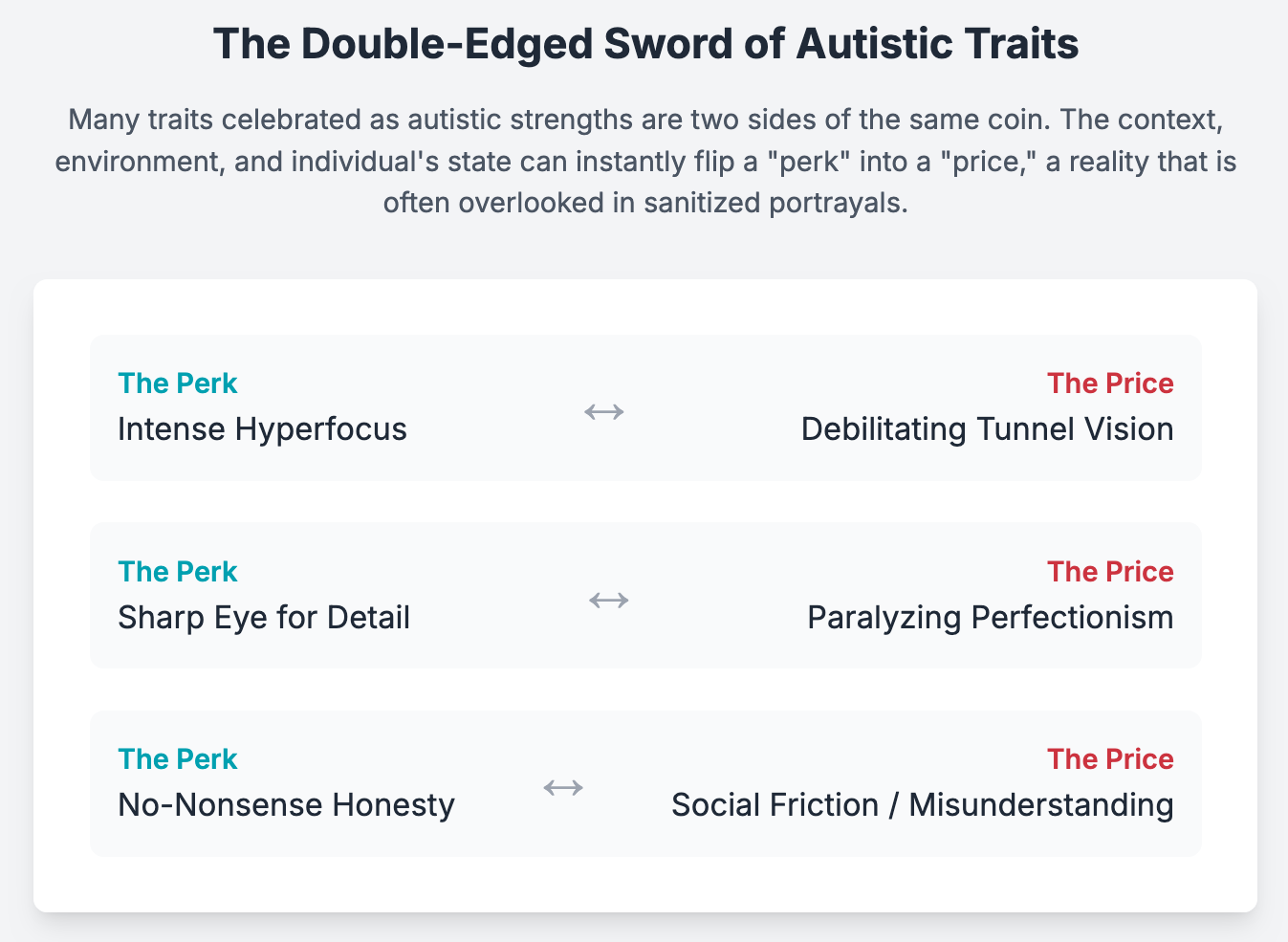
But the result is a kind of “autism à la carte.” The “cool” traits — like intense hyperfocus, unwavering loyalty, and a no-nonsense attitude — are increasingly in the spotlight, even when they aren’t exactly universal autistic experiences.
Meanwhile, the more experienced struggles — the sensory sensitivities, the chronically drained social battery, the debilitating meltdowns — are quietly swept under the rug in our public conversations and portrayals.
The Allure of an Answer
Discovering you’re autistic can be a profound turning point. It can reframe your entire life story. All those struggles you faced? Not personal failures, but at least partly explained by the unique wiring of your brain.
Suddenly, you might find people you don’t have to constantly perform for — people you never thought existed. What a relief that can be, at least for those of us who enjoy the company of other autistic or neurodivergent individuals.
Thanks to the trendy and influential neurodiversity movement, it often feels like we’ve stopped focusing only on the “deficits.” The narrative in media and personal stories now leans heavily towards talents, like that incredible hyperfocus or a sharp eye for detail.
But in this sanitized image, there’s little room for the flip side. Yet, every “advantage” has its cost, and whether it’s seen as a strength or a weakness often depends entirely on context, environment, or even pure chance. That same hyperfocus can become debilitating tunnel vision in an instant. That eye for detail can manifest as paralyzing perfectionism or infuriating nitpicking. If we only celebrate the palatable parts, are we turning the challenging realities into a private, invisible burden for each individual to bear alone?
Fleeing from the Core of the Condition
It’s human nature to want to belong and not cause trouble, and autistic people are no exception. That’s why many of us also push away the very things that make us most vulnerable. I’m not talking about the “quirky” traits, but the actual core of autism. The diagnostic criteria that scientists agree on, the very reasons most autistic people seek help in the first place.
I’m talking about the constant mental energy it takes to “translate” social small talk. Or how essential strict routines are to manage the chaos in your head. It’s that trip to the shopping mall that can feel like a full-blown sensory assault. It’s an emotional outburst that isn’t a tantrum but a complete system crash in your brain.
These are the things that make us vulnerable, and they don’t fit neatly into the “super-autist” narrative. Because it’s not “normal,” we all feel the pressure to hide this part of ourselves. But in doing so, we ignore what, for many, is the central truth: in many crucial situations, contexts, and environments, autism is, first and foremost, a disability.
What’s Left of Autism?
Some voices in the autism community are rightly asking: if we continue down this path, what will “autism” even mean? They worry it’s becoming a fashionable label for anyone who feels a bit different (and let’s be honest, everyone is a bit different).
Press enter or click to view image in full size

This fear sometimes leads them to write about “the end of autism” or harbor a secret nostalgia for a time when autism was broken down into subcategories. They muse about creating new classifications, whether based on genetics, biology, or philosophy. They argue that without clearer boundaries, the term loses its power. And they pose a critical question: how will people with deep, profound, and severe struggles get the help and understanding they desperately need? But I wonder: as if a new classification system would magically provide a solution for that.
In the end, contrary to what some on social media seem to believe, autism isn’t a menu where you can pick and choose the most appealing dishes. It’s the full, fixed-price meal. It’s the autistic way of thinking, the autistic brain, the specific way you taste and experience the world. Sometimes that includes delightful flavors, but it also comes with severely burnt food.
Accepting yourself as an autistic person doesn’t mean denying or pushing away the difficult parts. An honest conversation isn’t about good sides versus bad sides; it’s about embracing the whole, complete package. Only when we dare to tell the entire story can we start building a world that truly has a place for everyone. A world that sees your talents but also offers you a hand when things get tough. Because those perks and that price? They belong together.

 The European Autist