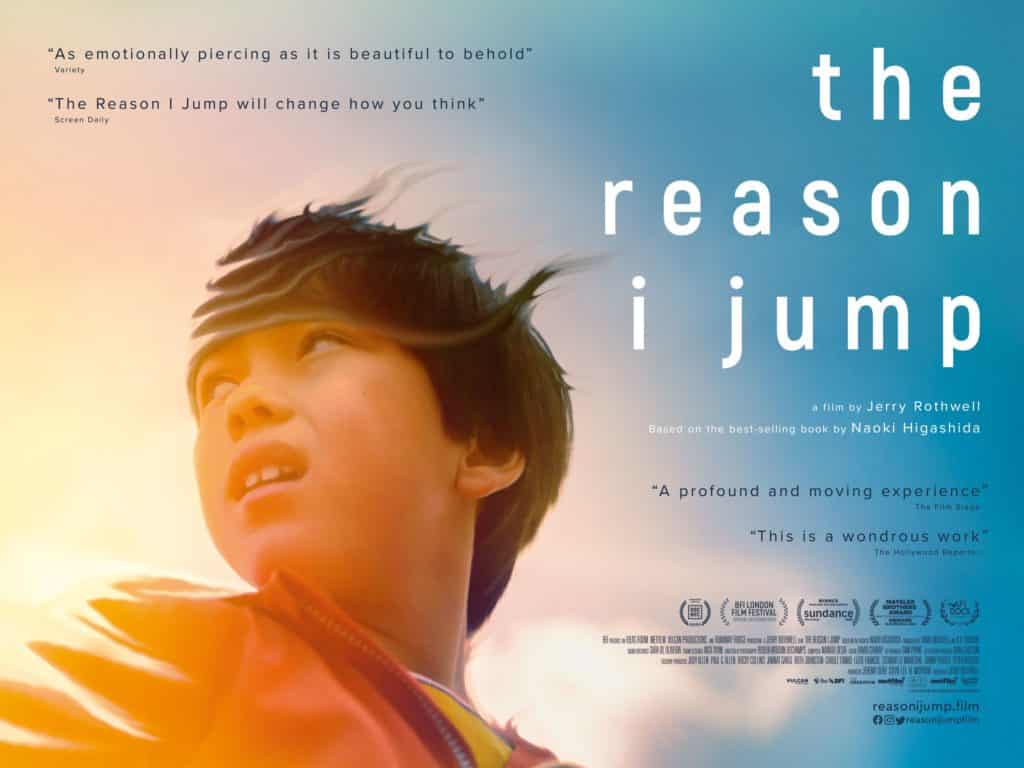
In recent decades, autism has increasingly become a topic in films, series and in pop culture in general. As We See It, Everything’s gonna be ok, Hors Normes, Follow the SOA, The Good Doctor, Float, The Bridge… are just a few of the documentaries, series or movies that may sound familiar.
In the coming weeks, another of these productions, the documentary ‘The Reason I jump’, will hit our screens in Europe. This documentary from award-winning filmmaker Jerry Rothwell was also selected for the annual Disability Film Festival in Leuven (Belgium) in the beginning of May. I was already allowed to watch the film, and on May 12 I am invited by the Flemish Autism Association to introduce the screening of this wonderful work of art.
With ‘The Reason I Jump’ Rothwell mainly wanted to make a film in which autism is explored ‘from the inside’. The basis for this is the book of the same name by the autistic writer Naoki Higashida, who at the age of 13 described his experiences and feelings as an autistic person amid neurotypical people.
The now 29-year-old Japanese did not want to participate in the film. That’s why director Rothwell interweaves the stories of Naoki Higashida with the images and stories of five young autistic people in India, the UK, the US, and Sierra Leone. A narrator uses Naoki’s words to guide you through the world of non-speaking autistic people. Reviews from the American press were mostly positive, and in 2020 the film even won the audience award at the Sundance Film Festival.
From the beginning of the film, there seem to be only two worlds: the enigmatic of the neurotypicals and the mysterious of the autistic people. The voice of a narrator takes the viewer on an 83-minute illuminating, compelling and loving film that immerses you in the stories of non-speaking autistic people.
All kinds of cinematic techniques are used in a creditable attempt to make an autistic experience tangible. The autistic people in the picture are shown in their daily lives in seemingly unnoticed, personal moments, but also in stressful and overstimulating situations. This results in a lot of enlightening, poetic, and sometimes quite poignant moments.
It goes without saying that involving these autistic people does not immediately mean that ‘The Reason I jump’ as a film or documentary does justice to all autistic people. Although I don’t have the impression that the director has any pretensions to turn this ‘participation’ into a ‘representation’.
What he does seem to want to show is the dizzying gap between the valuable experience of some autistic young adults and the image that their speaking environment has of them.
For the parents and other relatives of the people in the documentary, for example, autism is essentially a misfortune, an ‘evil fate’, a contrast to the life they live. This seems to be mainly due to their focus on spoken language as the only valuable means of communication. The various other forms of communication such as body language, sign language, electronic tools… are considered artificial.
According to our society, anyone who does not share the fixation on spoken language as the only accepted form of communication must lack intellectual capacity and awareness. For example, Amrit Khurana, a young woman with great talent and a rich inner life, is portrayed as a dependent, immature child only because of her shortcomings and other form of communication.
The unworldliness of society is portrayed even more poignantly when you consider the vehement demand to see non-verbal communication such as facial expressions, gestures, and body language on an equal footing. Instead, their environment often presupposes what they think and want, only to bring those assumptions out as their voices.
It reminds me, among other things, of passages from the book ‘Ongehoord: about small interactions when words are not self-evident’ , selected by Dr. Leni Van Goidsenhoven. In this wonderful book, writers, artists, therapists, and remedial educationalists take the reader into their thinking about the theme ‘ alternative forms of communication’ and about what meeting and interaction means when words are not self-evident.
In ‘The Reason I Jump’, the autistic persons can, with the use of letter boards, arrive at a form of communication that also accepts their environment. This is not a panacea, but the help of the letter boards seems to change a lot.
“You can take classes for the first time,” says Emma Budway’s mother, who seems to believe that her child has only now acquired intelligence, as if she hadn’t been able to learn and experience before using this map. Another mother realizes she’s been preventing her autistic daughter from being herself for years, and challenges ancient Sierra Leone myths that autistic people are possessed by demons.
It is one of the few moments in the film in which the gap between autistic people and their environment seems to become less deep. While autistic people still live in the same world and are equally entitled to freedoms. This documentary is not only worth watching for that reason. It also offers a beautiful representation of the difficulty neurotypical people have in contacting people who do not have the same communication style and who live in a strange, unfamiliar culture whose rules and logic seem incomprehensible.
Overall, I had a positive feeling about this documentary. It is clearly aimed at the parents, family and people who frequently meet autistic people. Still, I think she can also provide a lot of insight to more verbal autistic people who often mistakenly attribute intellectual deficits to non-verbal autistic people. Care providers and therapists can also learn something from this documentary. They could identify with the parents of the main characters and wonder about the way they speak about autism.
Finally, it is important to have the right expectations before watching this documentary. The Reason I jump is clearly not a Hollywood-esque film adaptation, a love story between two autistic geniuses, or a biopic of a creative genius with autism. It is an indictment and a critical view on the ‘valid’ worldview, on what we consider ‘normal’ in our daily communication and society. It tries to portray the lives of autistic people who communicate in a way other than spoken language. People who would prefer to remain as they are. But even more, it exposes the gap between people with and without autism, between autistic people, but also the inability of non-autistic people to, despite their abilities.


