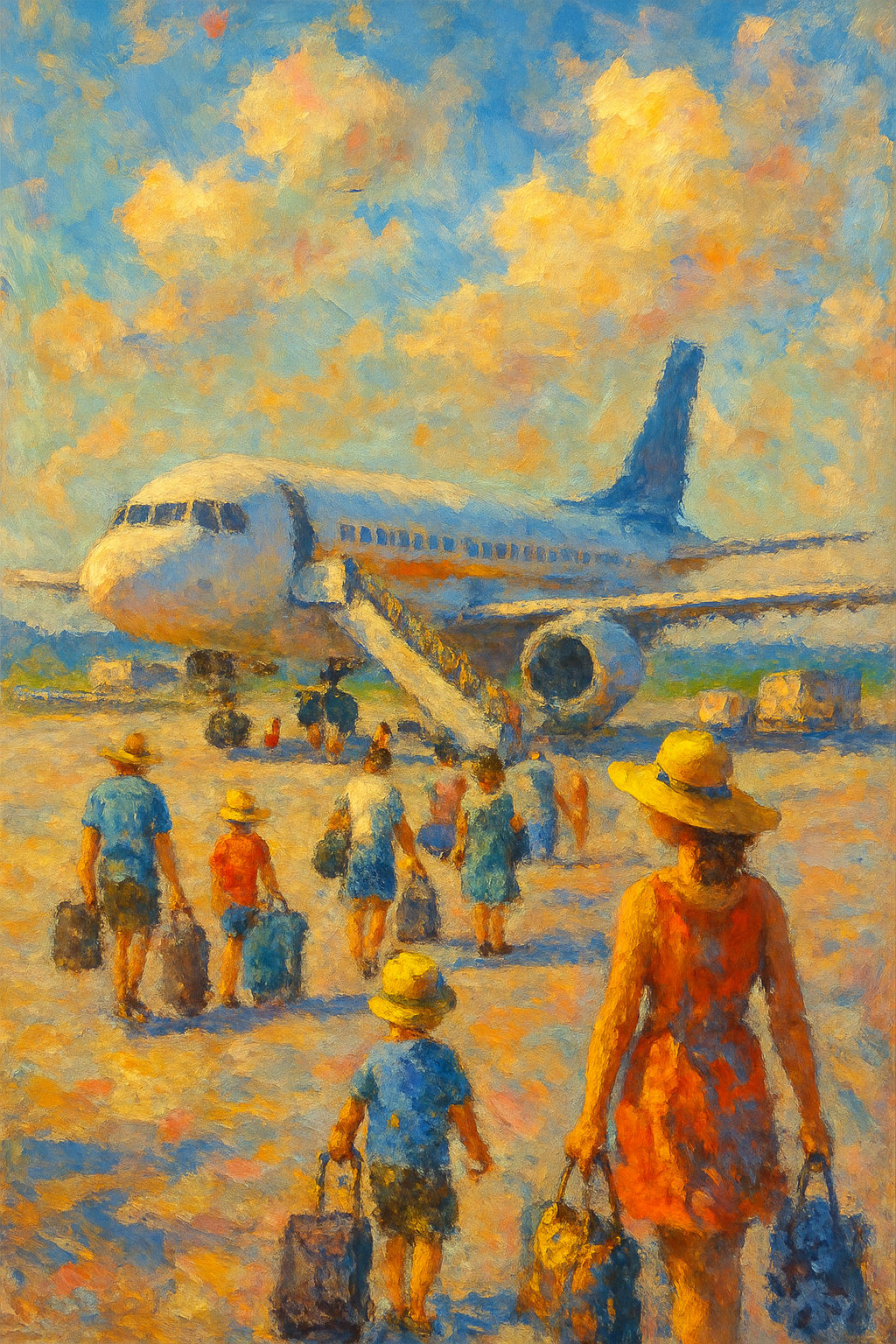
Travel is often seen as liberating—a chance to discover new places, break routines, and feel free. But for many autistic individuals and their families, traveling can be something else entirely: overwhelming, unpredictable, and exhausting. From airports to unfamiliar hotel rooms, the sensory, social, and logistical hurdles can be immense. Yet research and lived experience converge on one key point: with the right supports, autistic people can travel not just safely, but meaningfully and joyfully.
Why Travel Can Be So Challenging for Autistic People
Autistic individuals often experience the world through heightened or atypical sensory processing. Sounds may seem louder, lights more glaring, and changes more disorienting. Add in the unpredictability of air travel or public transport, and you have a recipe for sensory overload, shutdowns, or intense anxiety.
But here’s the truth, and many self-advocates echo this: autistic people are not inherently “bad” at traveling—our environments just weren’t designed with us in mind.
Edwards et al. (2025) emphasize this in their study on airport accessibility: the problem is rarely the autistic traveler, but rather the chaotic, non-inclusive systems we expect them to navigate.
Sensory and Environmental Adaptations: Creating Calm in Chaos
Lived experiences make clear what the research supports: autistic-friendly environments reduce stress and increase autonomy.
Quiet Rooms and Sensory Zones: Access to low-stimulation environments (quiet waiting areas, dim lighting, calming visuals) can drastically reduce the risk of sensory overload. In interviews, autistic adults often mention retreat spaces as their “lifeline” in overstimulating places like airports or train stations.
“If I know there’s a quiet room nearby, I can actually breathe while I wait for my gate. It makes the whole journey manageable.”
— Leo, 34, diagnosed autistic at age 27
Predictable Layouts and Clear Signage: Wayfinding tools like floor maps, arrows, and color-coded signs make navigation less cognitively demanding. They reduce the need for verbal instructions—something many autistic travelers find stressful (Edwards et al., 2024).
Noise-Cancelling Headphones and Sensory Kits: Many autistic travelers carry their own coping tools. Headphones, fidget toys, sunglasses, or weighted items create a mobile bubble of control.
Communication and Preparation: Knowing What to Expect
The fear of the unknown can be more debilitating than the journey itself. Structured preparation is therefore key.
Visual Schedules and Social Stories are frequently recommended by professionals (Edwards et al., 2025), and widely endorsed by autistic travelers. They offer a visual preview of each travel step—from packing to boarding.
Virtual Reality (VR) Practice: Research shows that VR rehearsals can increase confidence and decrease anxiety. A 2020 study by Miller et al. used VR to simulate airport experiences for children on the spectrum. Results showed reduced anxiety and improved coping skills.
“The first time I flew alone, I watched YouTube videos of every step—security, customs, boarding. It’s like making a map for your brain.”
— Jade, 22, non-speaking autistic traveler
Communication Cards and AAC Tools are crucial for those with limited verbal speech. These allow the person to express needs quickly—especially important in high-pressure environments like passport control.
The Role of Families and Social Support
Autistic people don’t travel in isolation. For children and teens, parents often act as advocates, buffers, and interpreters. For adults, travel may shift toward independence, but social support remains crucial.
Family Travel as a Bridge: Zhao et al. (2023) note that many families begin with close-to-home travel, gradually building up to longer or more complex trips. With each success, confidence grows.
Specialized Travel Agents can provide autism-informed trip planning. David Barclay (2022) advocates for agencies that understand sensory needs, communication preferences, and routine disruption.
“We booked a trip through an autism-aware travel service—they found a hotel with blackout curtains and sent us the menu in advance. It was the first time we didn’t feel like a burden.”
— Mira, parent of a 10-year-old autistic child
Staff Training and Policy: Human Factors Matter Most
Even the best infrastructure can fail without trained, compassionate staff. Edwards et al. (2024) stress that autism training for airport and hospitality staff is not optional—it’s foundational. Recognizing sensory distress, allowing extra time, or adjusting communication style can prevent escalation.
Hidden Disability Lanyards (like the Sunflower symbol) provide a discreet way to indicate the need for extra support. But as several autistic individuals point out, the success of these programs depends entirely on staff recognition and response.
“Wearing the lanyard helped—once. The second time, the staff didn’t even know what it meant.”
— Tom, 28, autistic and visually impaired
Common Stressors and Proven Strategies
| Travel Stressor | Recommended Support Strategy |
|---|---|
| Crowds, long lines | Quiet spaces, fast-track programs, priority boarding |
| Sensory overload | Noise-cancelling headphones, sensory kits, access to calm zones |
| Unpredictable transitions | Visual schedules, storyboards, rehearsals, mobile alerts |
| Communication difficulties | Communication cards, trained staff, visual icons |
What Does Inclusive Travel Really Mean?
Inclusive travel doesn’t mean making everyone travel the same way—it means valuing different ways of being in the world. For autistic travelers, inclusion looks like flexibility, predictability, and genuine understanding. It’s about acknowledging difference, not erasing it.
Traveling while autistic is not only possible—it can be liberating. With the right strategies, it becomes an act of autonomy, of joy, of connection to a broader world that, slowly but surely, is learning how to meet us halfway.
References
- Edwards, C., Love, A., Cai, R., Tutton, T., Beardsley, E., & Gibbs, V. (2025). Autistic-led insights on airport accessibility. Autism: The International Journal of Research and Practice. https://doi.org/10.1177/13623613251337200
- Edwards, C., Love, A., Cai, R., Tutton, T., & Gibbs, V. (2024). Exploring autism-friendly initiatives in Australian airports. Current Issues in Tourism. https://doi.org/10.1080/13683500.2024.2422049
- Dempsey, R., Healy, O., Lundy, E., Banks, J., & Lawler, M. (2021). Air travel experiences of autistic children/young people. Annals of Leisure Research, 2, 100026. https://doi.org/10.1016/J.ANNALE.2021.100026
- Miller, I., Wiederhold, B., Miller, C., & Wiederhold, M. (2020). Virtual Reality Air Travel Training with Children on the Autism Spectrum. Cyberpsychology, Behavior and Social Networking. https://doi.org/10.1089/cyber.2019.0093
- Zhao, Z., Shi, D., Qi, X., Shan, Y., & Liu, X. (2023). Family travel among people with autism: challenges and support needs. International Journal of Contemporary Hospitality Management. https://doi.org/10.1108/ijchm-10-2022-1229
- Barclay, D. (2022). Traveling Different: Vacation Strategies for Parents of the Anxious, the Inflexible, and the Neurodiverse. https://doi.org/10.5771/9781538168677

 The European Autist