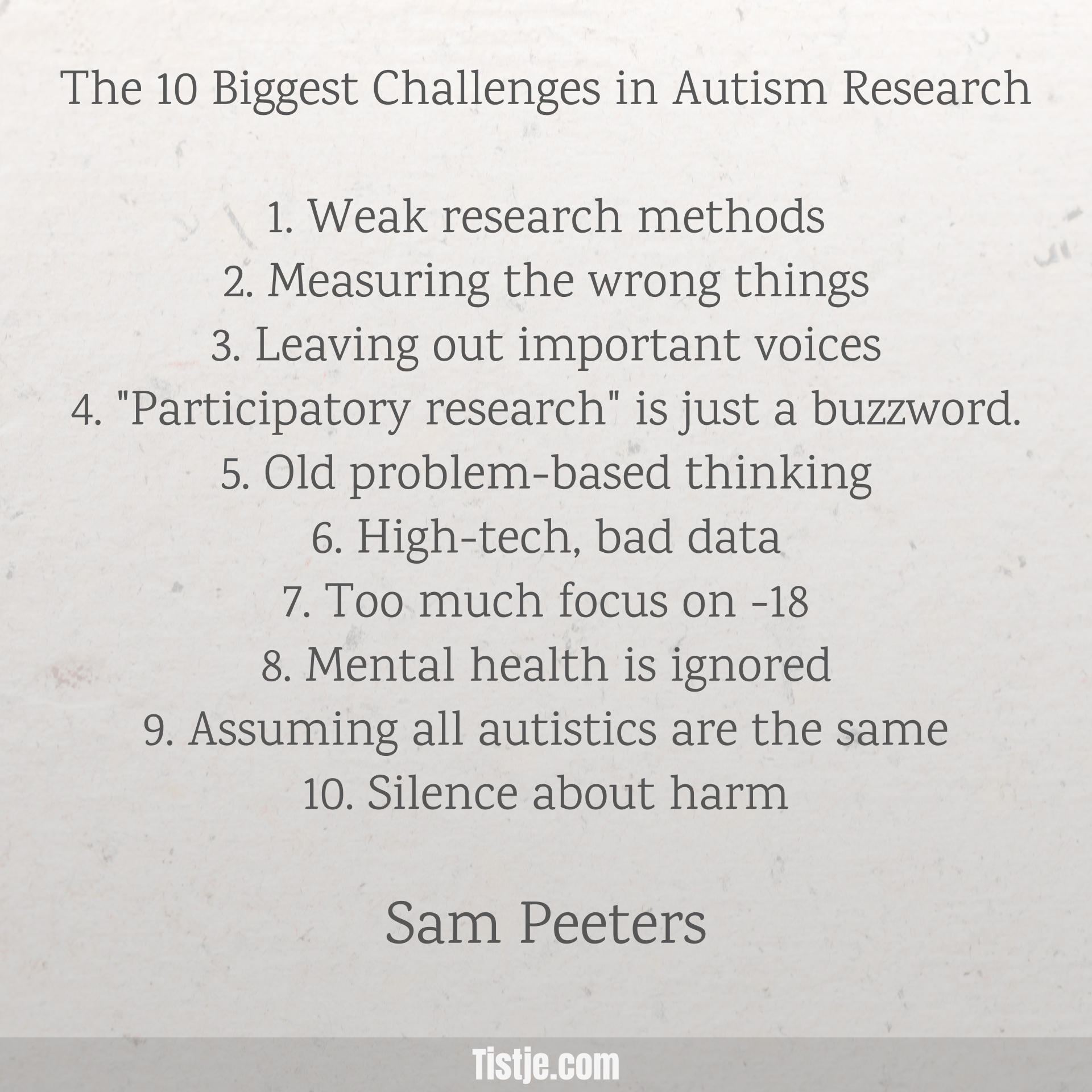
As someone who lives and breathes autism—both from the inside and through the lens of hundreds of studies, books, and personal testimonies—I often feel torn. On the one hand, I deeply believe in the potential of research to make our lives better. On the other hand, I keep stumbling over the same cracks in the system. And the cracks are not small. They are gaps wide enough to fall through.
Here’s how it looks and feels from where I stand—an autistic adult, writer, reader, observer—walking the fault lines of what’s often called “autism science.”
1. Weak Research Methods That Miss the Mark
I’ve read studies where the sample size was so tiny it could’ve fit in my living room. Others where “randomized” turned out to mean “whatever was easiest.” And don’t get me started on the absence of long-term follow-up. Especially when it comes to autistic adults in major life transitions—starting university, job-seeking, navigating independence—the data just dissolves. We are expected to survive on shaky assumptions.
2. Measuring the Wrong Things
Why is so much research obsessed with behavior? How we talk, how we sit, how we move our hands. As if we were performance machines, not feeling beings. Rarely do I see studies asking about meaning. About peace, belonging, identity, or joy. If you measure eye contact but ignore whether someone wants to live another day—what exactly are you studying?
3. Excluding the Margins (Which Are Actually the Majority)
The research world still centers a very narrow slice of autism: usually white, Western, cis male, with high verbal skills. Where does that leave everyone else? Autistic women, nonbinary folks, racialized people, those with intellectual disabilities, and anyone outside the diagnostic mainstream. I read these studies and often wonder: where are we? And worse—who gets left out on purpose?
4. Participation That’s Cosmetic, Not Structural
“Participatory” is the buzzword of the decade. But being invited to review a draft or give feedback on a survey after it’s already designed is not the same as co-creating it. When autistic voices are only sprinkled in for flavor, not baked into the structure, it’s not partnership. It’s window dressing. Especially when self-diagnosed people are dismissed as “less valid”—even though they often have sharper insights than so-called experts.
5. The Tyranny of the Deficit Model
So much research still starts from the assumption that autism is something broken. A puzzle to solve. A burden to lighten. That framing is not just exhausting—it’s violent in subtle ways. Where are the studies that start by asking: what do autistic people value? What kinds of intelligence go unnoticed? What creative or ethical insights emerge from difference? Instead, I see papers trying to predict, prevent, or “treat” people like me.
6. High-Tech Hype, Low-Sensitivity Tools
AI is the shiny new toy in autism research. But if the datasets are riddled with bias—and many are—then all we’re doing is building faster, shinier ways to misrepresent us. Tech that flags “abnormal” speech or facial expressions might claim to help diagnose us, but who defines what’s abnormal? If the machine doesn’t understand context, it becomes just another tool for sorting, ranking, and excluding.
7. Everything Ends at Age 18
It’s like the research lights go off the moment we turn 18. Suddenly, the questions dry up. Love, work, housing, trauma, community—none of it seems sexy enough for a grant proposal. But this is where our lives really begin. Adult autism is not a niche topic—it’s a massive, neglected continent. I want to see maps drawn for the roads we actually walk.
8. Mental Health Gets Sidelined
You can’t separate autism from mental health. Not when so many of us wrestle with anxiety, depression, burnout, trauma, masking fatigue. And yet mental health is too often treated as a footnote. A secondary issue. Or worse, something we’re blamed for. We need research that dares to ask how social exclusion, invalidation, and chronic adaptation shape our inner world. Because the pain is real—and research should help us carry it.
9. Still Treating Autistics Like a Single Tribe
There’s no such thing as a “typical” autistic person. Some of us stim loudly and love chaos. Others crave silence and routine. Some are highly verbal; others communicate through art, gesture, or not at all. And yet so many studies act like we’re one cohesive block. This not only distorts the data—it erases people. Research needs to reflect the diversity it claims to study.
10. The Silence Around Harm
This one troubles me most. I’ve seen studies touting the success of interventions without mentioning the distress they caused. No talk of shutdowns, trauma, sensory overload, or long-term damage. Just shiny graphs. When harm isn’t reported—or worse, isn’t even measured—it becomes invisible. And invisible harm gets repeated. Again and again
Final Thoughts
I want to believe in research. I do believe in it. But it needs to do better. Not just in methods or metrics, but in mindset. It needs to stop studying us from the outside like curious fish in a bowl—and start listening from within.
I want to see research that makes my community feel seen. That understands why burnout matters more than eye contact. That values lived experience as data. That explores not only how we struggle, but how we make meaning.
Because until that happens, most autism research will keep feeling like a conversation about us, held in a room we’re not allowed to enter.


