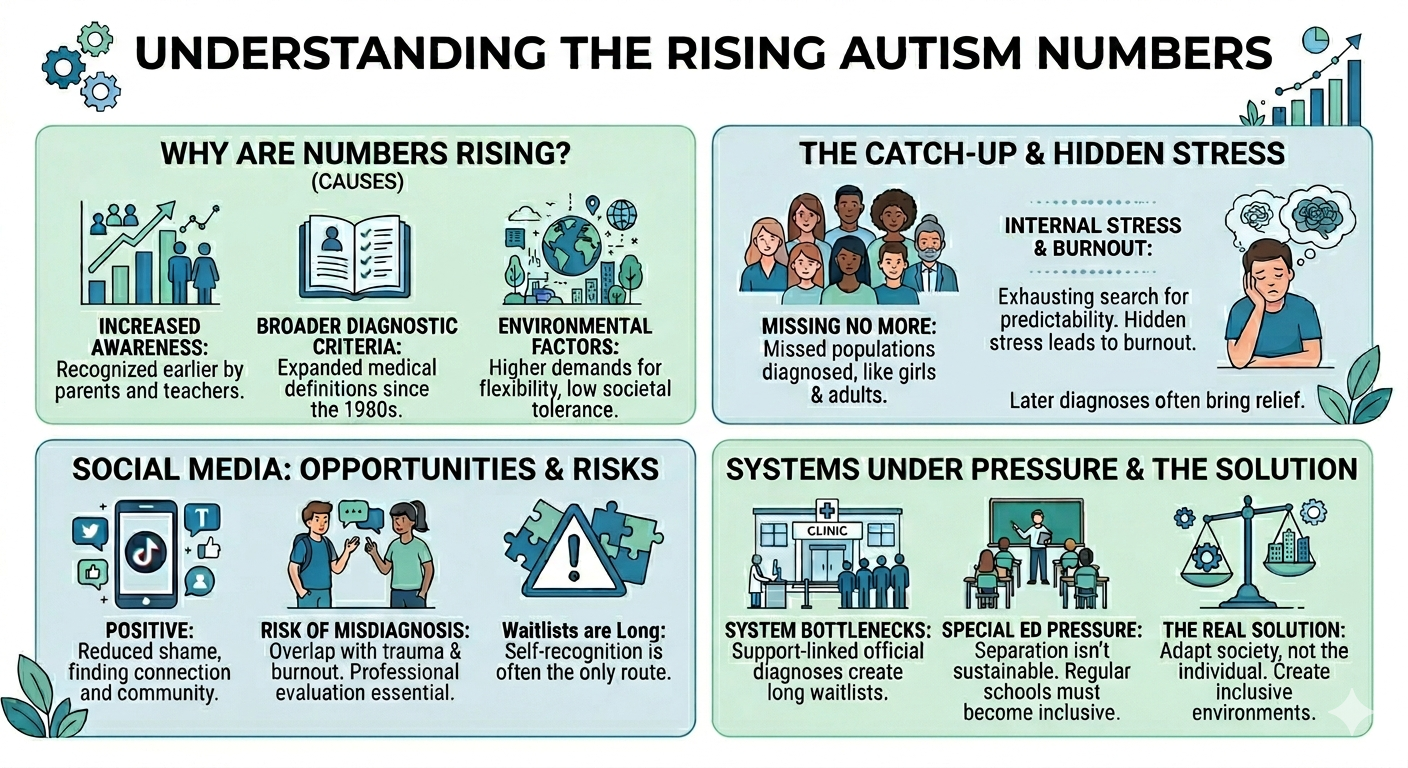
The numbers are clear: autism diagnoses are rising very fast in many countries. Long ago, people rarely talked about autism. Today, it is a major topic in schools, healthcare, and on social media like TikTok. A recent investigative article in the Belgian newspaper De Standaard highlighted these growing statistics, causing a lot of public discussion. But what do these high numbers really show us? Do they show a change in autism itself, or do they tell us something about our busy modern world?
To find a real answer, we must look at different sides. For some people, autism is a serious disability that makes daily life very difficult. For others, it seems, to them, a different way of thinking and seeing the world. Both sides are not less true, and they can exist at the same time. If we want to understand the situation, we need to listen to both experiences without judgment.
A Huge Jump in Global Statistics
In many wealthy countries, the number of diagnoses is growing fast. For example, researchers in the United Kingdom found a 780 percent increase between 1998 and 2018. In Sweden, four to five times as many children had an autism diagnosis in 2024 compared to 2008.
The region of Flanders in Belgium shows the same trend, some say. In secondary schools, about 3 to 4 percent of students now have a “type 9” status. This status is for students with autism who do not have an intellectual disability. In just five years, this group grew by 83 percent.
Doctors and experts explain that this is not a medical “epidemic.” Instead, it shows among other things that teachers and parents notice the signs much faster. Also, the official medical definitions of autism have become much broader since the 1980s.
However, our environment also plays a big role. We live in a society that is far less tolerant to those who are different and there are higher demands a lot of planning, flexibility, and subtle social skills. Because of intolerance and far more economical striving, people with autism hit their personal limits much faster than before.
The Broader Catch-Up: Moving Past the Classic Clichés
A large part of the new numbers comes from a much-needed catch-up in diagnosing people who do not fit the traditional image of autism. For many decades, a lot of doctors (but not all) looked at autism through a different lens. They focused on more obvious behaviors, or remarkable specific interests like trains, timetables, and maps.
This old stereotype not only left out girls and women, it also missed many boys and men who did not fit this specific description. People who do not fit the classic picture often handle their difficulties different. They had the opportunity or (false) privilege to have more social behavior.
Some now call this ‘masking’, but this is not what makes school or work more exhausting. It’s the unpredicatability and constant and absolute searching of their brain for certainty in a rather relativ thinking world that makes them angry and tired. So instead of what smart marketeers say, unmasking will make no different, and may even be worse, because it increases vulnerability.
Often, the internal stress of the above stays completely invisible until they break down, sometimes only as adults. Many men and women only discover their own autism later in life—often after experiencing chronic burnout, or after their own children receive a diagnosis and they recognize the same traits in themselves.
For many adults who missed a diagnosis in their youth, finding out later in life brings great relief. It finally gives them a language for what they always felt. It stops them from thinking that something is deeply wrong with them, and it opens the door to a supportive community.
Yet, even with a diagnosis, many people still face old clichés within healthcare and society. Some doctors still doubt a person has autism simply because they can make eye contact, have a job, or talk easily. This shows we still need better, evidence-based care that looks past outdated myths and recognizes that autism looks different in every individual.
The Power and Risks of Social Media
Social media platforms like TikTok have a powerful double effect. On the positive side, they remove the shame around autism. Young people can easily find recognition and a welcoming community online. In the UK, about 10 percent of young people now describe themselves as autistic, which is much higher than official medical numbers.
However, this trend also brings risks. Many traits of autism look exactly like other issues, such as chronic burnout, trauma, or childhood attachment problems. Because of this, a professional medical opinion is still very important. A wrong self-diagnosis can lead someone to the wrong type of help.
At the same time, the medical system must stay humble. In places with long waiting lists—sometimes up to four years—or where private care is too expensive, self-recognition is often the only way in. We cannot complain about long waiting lines and, at the same time, look down on people who try to find their own answers because the official gate is locked.
Schools and Healthcare Systems Under Pressure
Right now, the care and education systems are struggling to survive. In many countries, families can only get extra financial support or help at school if they have an official piece of paper. This rule creates a massive bottleneck at diagnostic centers.
Special education is also feeling the pressure. In Flanders, requests for specialized secondary education rose by 42 percent in five years. While smaller classes and quiet rooms are a relief for these students, separating everyone who is slightly different is not a sustainable solution. Mainstream schools need to change, rather than pushing every unique student into a separate system.
Numbers and statistics show big patterns, but personal stories show the human reality. An honest debate needs both medical science and lived experience on equal ground.
The Real Solution: Working Together Now
The path forward lies in a balanced middle ground. This means two things: we must honestly accept the real, practical limits that come with autism, but society must also build calmer, clearer, and low-stimulation spaces.
Environmental modifications—such as creating clear communication, offering real rest periods, and keeping daily structures simple—benefit not only diagnosed individuals but the broader population as well. However, a true middle ground cannot mean that autistic people must accept their disability today while society promises to change “someday” in the future. That is not a balance; that is just asking a minority group to be patient while the majority changes nothing.
An honest solution requires action from both sides. It asks autistic individuals to recognize their boundaries. But it demands even more from society: to redesign workplaces and schools right now. Only when the structural burden is distributed equitably can healthcare and educational systems transition toward sustainable, long-term models of inclusion.


