Moving beyond labels in relationships to focus on safety, empathy, and your own needs for respect and clarity.
When relationship tension runs high, people reach for clarity. They go online and type: What is the difference between autism and narcissism? Not out of academic curiosity, but out of desperation — because something at home has broken down and they need a word for it. A category. A direction.
I understand that need. I have been writing about autism since a few years, and the question lands in my mail with striking regularity. Recently, I came across an article by a Dutch relationship coach drawing a sharp boundary between the autistic partner and the narcissistic partner. It was well-written and with good intentions. It also deserves a second look.
A Line That Looks Clean
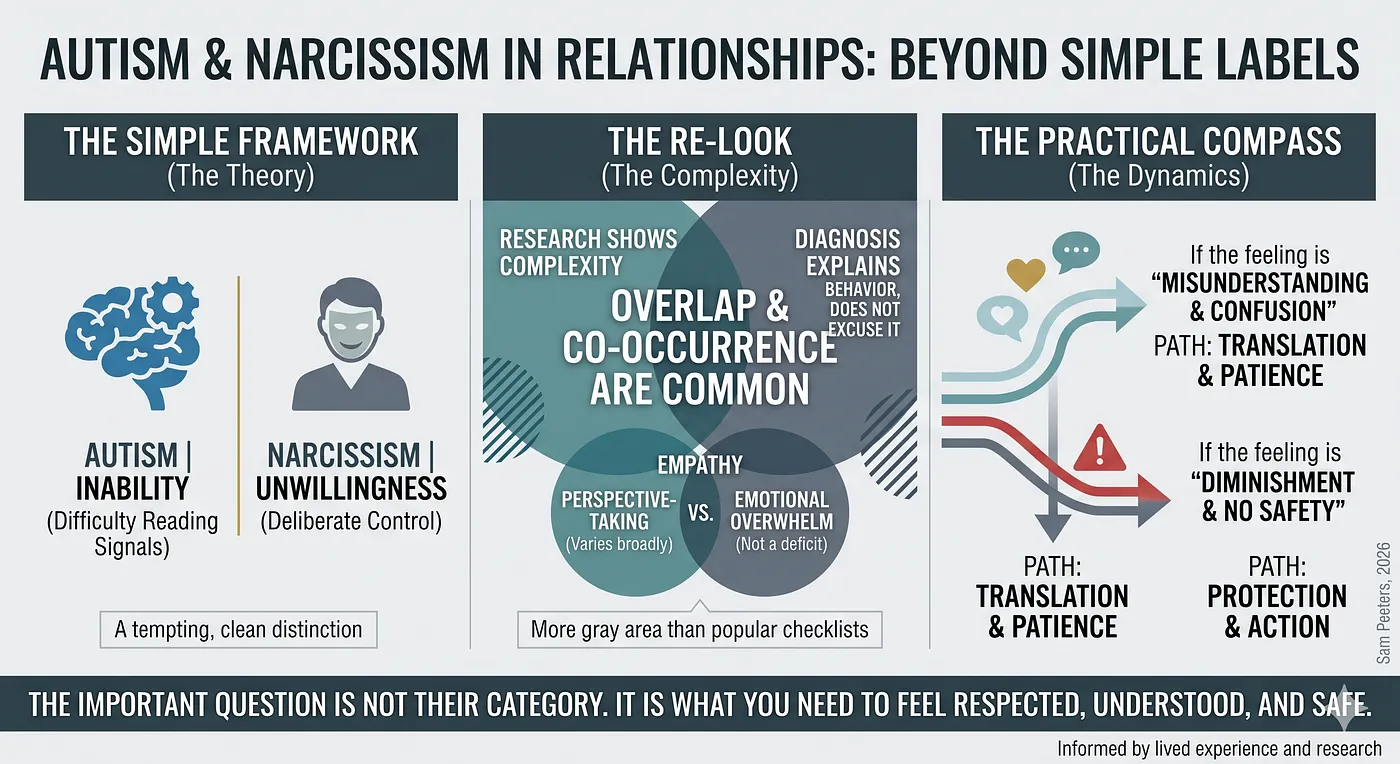
The standard idea about autism and narcisissm (as both clinical diagnosis) goes like this: autism is about inability, narcissism is about unwillingness. The autistic partner withdraws not out of manipulation, but because sensory overload has pushed them past their limit.
The narcissistic partner controls, diminishes, and isolates — deliberately, strategically.
Inability versus unwillingness. Neurodivergence versus character pathology.
That distinction offers real comfort to someone who is confused and hurting. It suggests that the chaos at home can be sorted into a box, and that the right box will tell you what to do next.
A diagnosis can explain behavior. It cannot excuse it. And it cannot replace your own assessment of whether you feel safe.
The problem is not that the distinction is wrong. The problem is that it is far cleaner on paper than in a living room.
What the Research Actually Shows
Scientific literature does not offer the clear dividing line that popular articles suggest. There is no validated test that neatly separates autistic behavior from narcissistic patterns. More importantly, researchers have established that autism and personality disorders co-occur at higher rates than most people assume. The DSM-5 focuses heavily on the grandiose, overt presentation of narcissism — the person who openly demands admiration and shows contempt. The quieter, more vulnerable variant is frequently missed, and its behavioral profile overlaps with other presentations in ways that confuse both clinicians and partners.
None of this means autistic people are narcissistic. The two are genuinely different things, rooted in different mechanisms. But human beings are not case studies. They carry multiple things at once, and the person across the table from you at dinner may not fit the profile you found online at midnight.
The Empathy Question
Empathy always becomes the centerpiece of this conversation. The shorthand version: autistic people struggle with cognitive empathy — reading minds, predicting reactions — but feel emotional empathy intensely. Narcissistic people are the reverse: sharp at reading others, cold in feeling for them.
It is a tidy contrast. It is also not quite right on either side.
For autism, the research picture is more complicated. Many autistic adults do experience genuine difficulty with perspective-taking. At the same time, a significant number describe absorbing other people’s emotions so intensely that it becomes overwhelming — a flooding rather than a deficit. Being overwhelmed is not the same as not feeling.
For narcissism, the image of the precise emotional predator does not fully hold either. People with pathological narcissism do lack genuine emotional empathy, but their ability to accurately read another person is often more limited than the popular image suggests. The manipulation is real. The insight into others is frequently less reliable than it appears.
The empathy tests circulating online will not give you a definitive answer. They are not designed to. They offer the feeling of certainty, which is a different thing entirely.
What the Dynamics Actually Look Like
Here is where the distinction becomes more practically useful — not as a diagnostic tool, but as a compass.
In relationships where narcissistic pathology is central, the recurring pattern is one of control, humiliation, and the systematic erosion of the other person’s sense of reality. Partners describe being isolated, belittled, made to feel responsible for everything that goes wrong. This is not a communication problem. It is a safety problem, and it requires a different response than better mutual understanding.
In relationships where autism plays a significant role, the pain is usually located somewhere else: in the gap between two very different ways of processing the world. Misread signals. Unmet expectations that were never clearly stated. Exhaustion on both sides from the effort of translating. This is genuinely difficult. It is also not the same thing as abuse, and relationships shaped by this kind of difference can be deeply loving and functional — when both people are willing to do the work of understanding each other’s logic.
The practical question is not what diagnosis fits? but rather: What does this feel like from the inside?
When the core feeling is we don’t understand each other, the relationship is asking for translation and patience.
When the core feeling is I am being diminished and I don’t feel safe, the relationship is asking for something more urgent.
Against the Comfort of Simple Labels
I am not arguing against diagnosis. I have written about the value of diagnostic frameworks for years, and I mean it. A framework gives language to experience. It opens doors to support. It can be an enormous relief.
What I am arguing against is the idea that a label — applied from a distance, by yourself, to someone else — resolves the complexity of what is actually happening between two people. The person reading a checklist at 2 AM, trying to figure out whether their partner is autistic or narcissistic, deserves more than a binary. They deserve an honest account of how genuinely hard this is to sort out.
If you are in a situation where you feel unsafe, get professional support — not to confirm a diagnosis, but to protect yourself. If you are in a situation where the difficulty feels more like confusion than danger, then the work is different: slower, more patient, and probably requiring more than one conversation and more than one perspective.
Inability and unwillingness are real. So is the gray area between them. Living in that gray area honestly, without reaching for false certainty, is harder — and more useful — than any checklist.
The most important question is not what category your partner belongs to. It is what you need in order to feel understood, respected, and safe. Start there.
Written from lived experience. Perspectives here are informed by both personal knowledge and scientific literature, and do not constitute clinical advice.


