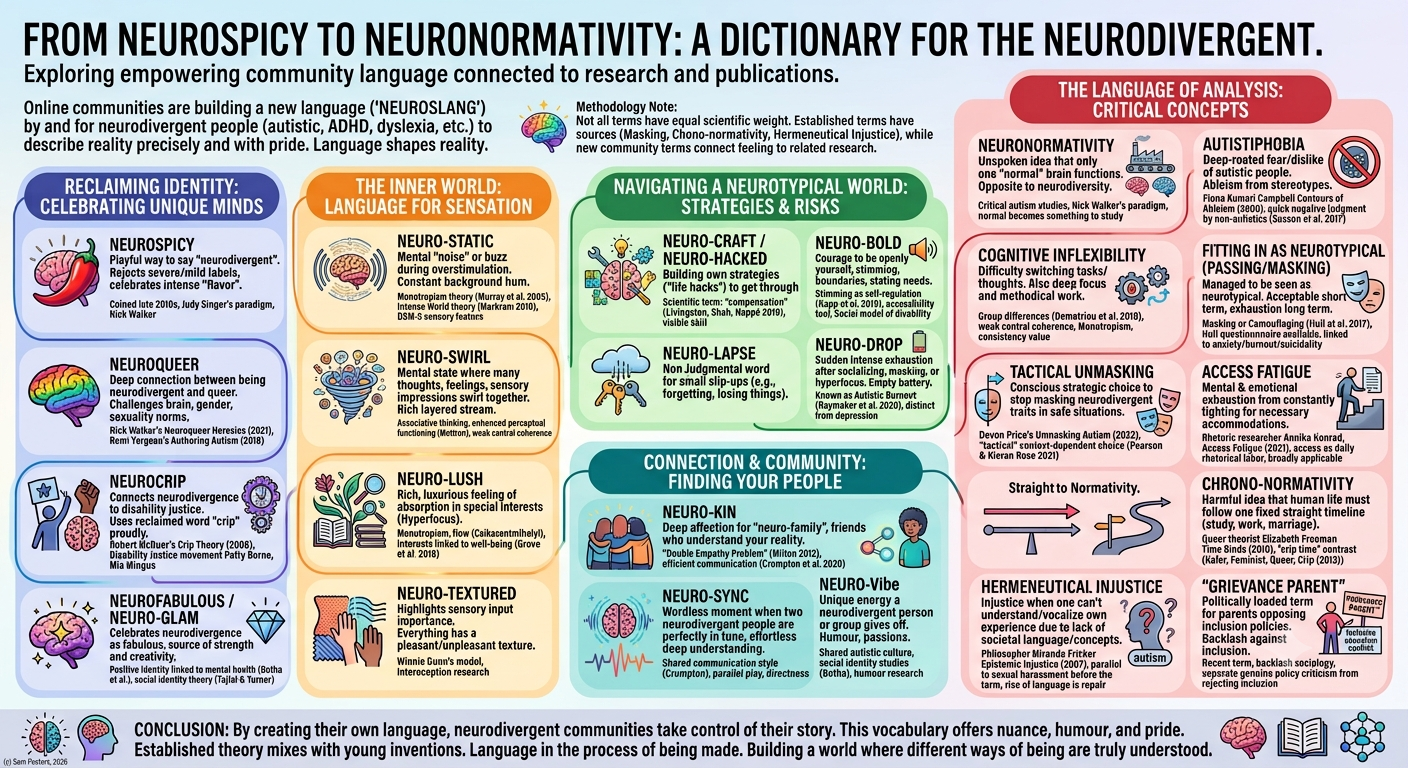
Online communities today are building a new kind of language. This language is made by and for neurodivergent people — people whose brains process the world differently, such as autistic people, people with ADHD, or people with dyslexia. Words like “neurospicy” are now reaching a wider audience, but they are only the beginning of a much bigger movement in language.
This vocabulary is often called “neuroslang.” It is more than a list of trendy words. It is a way to describe your own reality without clinical or negative labels. Instead, the words are often empowering, precise, and funny. This dictionary explores that growing vocabulary. Each term is connected to research, books, and publications, so we can understand both the inner experience and the bigger social picture.
Language shapes reality. Whoever shapes the language helps decide who counts as “normal” — and who does not.
A note on method. Not every term here has the same scientific weight. Some words are well established in research or community writing, with clear sources you can trace (like neuroqueer, masking, access fatigue, chrono-normativity, and hermeneutical injustice). Other words — especially the ones describing inner experience — are new community inventions without their own research history. For those, we connect the feeling to related, well-documented research. The source supports the experience, not necessarily the exact word. This difference is intentional and important to keep in mind.
The Language of the Community
The heart of neuroslang is made of words that celebrate identity and give names to inner experiences. These words often replace medical labels with a language of self-acceptance and recognition.
Reclaiming Identity
Neurospicy
A playful and popular way to say “neurodivergent.” It rejects the idea of “mild” or “severe” diagnoses and instead celebrates the unique, intense “flavor” of a brain that works differently.
The word has been used since the late 2010s, mostly on TikTok and in English-language online spaces. It builds on the neurodiversity paradigm, a term shaped by sociologist Judy Singer in the late 1990s. Researcher Nick Walker later made an important distinction: a person is “neurodivergent,” while “neurodiverse” describes a group. “Neurospicy” avoids the old labels of “high-functioning” and “low-functioning” on purpose. This fits research showing those labels are unreliable: one study found that “high-functioning” often hides how much daily support autistic people actually need, and another found that autistic communities themselves prefer identity-affirming language over clinical terms. So the playful tone is not denial of real struggles — it’s a shift in who gets to choose the words.
Neuroqueer
This word recognizes the deep connection between being neurodivergent and being queer — an experience that challenges norms around both brain function and gender or sexuality.
Nick Walker coined the term in 2008, first as a verb (“to neuroqueer”), and later explored it fully in her book Neuroqueer Heresies (2021). She describes neuroqueering as breaking both neurological and heteronormative expectations at once — for example, by stimming openly instead of keeping “quiet hands.” Researcher Remi Yergeau developed a related idea in Authoring Autism (2018), calling it “neurological queerness.” Studies also show a real overlap: neurodivergent people identify as LGBTQ+ more often than their neurotypical peers, and gender-diverse people are more often neurodivergent too. So “neuroqueer” is not simply adding two identities together — it’s a way of questioning the idea of a “normal brain” and a “normal body” at the same time.
Neurocrip
A politically charged term that connects neurodivergence to the wider disability justice movement. It’s used by people who experience their own neurotype as a disability.
“Crip” is a reclaimed word — it comes from the insult “cripple” but has been turned into a proud, activist term within the disability community. Robert McRuer laid the theoretical groundwork in Crip Theory (2006), showing how ableism and heteronormativity work together as connected systems. The disability justice movement — shaped by groups like Sins Invalid and thinkers such as Patty Berne and Mia Mingus — pushes this further: justice should start with the people who are most pushed to the margins, including race, class, and queerness, not just with equal rights for an “ideal” disabled person. “Neurocrip” places neurodivergence firmly inside that framework. Unlike a purely proud framing, this word doesn’t try to erase discomfort. Disability is not reframed as secret strength here — it’s recognized as a political and material reality that calls for collective solidarity.
Neurofabulous / Neuro-Glam
Two words that celebrate neurodivergence as something fabulous and stylish. They express pride and see one’s neurotype as a source of strength and creativity.
These are recent community inventions without their own research base, but the feeling behind them connects to real studies. Researcher Monique Botha and colleagues found that a positive, affirming autistic identity — and connection to a community — is linked to better mental health and less internalized stigma. This fits classic social identity theory (Tajfel and Turner), which shows that reframing a stigmatized group membership in a positive way is a common and healthy strategy for protecting self-esteem. Still, one warning is worth noting: a purely celebratory framing risks hiding real struggles and the real need for support — a tension that critical autism researchers often point out as the risk of a one-sided “strengths narrative.” “Neurofabulous” works best as an antidote to shame, not as a denial of difficulty.
The Inner World: A Language for Sensation
Neuro-Static
Describes the mental “noise” or static buzz in the brain during overstimulation or when it’s hard to concentrate — the constant background hum of a brain that never quite goes quiet.
This is a community-created, experience-based term, but it connects to research on sensory processing and cognitive load. The monotropism theory, developed by Dinah Murray, Mike Lesser, and Wenn Lawson (2005), describes autistic attention as a system that goes very deep into a few channels at once. When the environment pushes too many competing signals at the same time, overload can feel exactly like “noise.” The “intense world” theory by Henry and Kamila Markram (2010) explains this at a neurological level, describing hyperreactive and highly connected sensory brain circuits. Sensory overstimulation is also an official diagnostic feature of autism in the DSM-5. So “neuro-static” doesn’t describe a lack of attention — it describes the opposite: a system that registers input so completely that it can become overloaded.
Neuro-Swirl
Describes the mental state where many thoughts, feelings, and sensory impressions swirl together at once — a rich, many-layered stream of information.
This is also a community coinage, but the experience matches research on associative, “bottom-up” thinking. While monotropism explains the deep attention tunnel, Laurent Mottron’s model of “enhanced perceptual functioning” (2006) explains why autistic people often notice detail first and intensely, creating a richer, less filtered stream of incoming information. Research on “weak central coherence” (from Uta Frith and Francesca Happé) describes something similar: a processing style that doesn’t automatically compress everything into one single summary, so more parallel details stay active at once. What looks chaotic or distracted from the outside can actually be a dense, layered way of thinking from the inside. The term is useful because it names that simultaneous experience without immediately turning it into an “attention problem.”
Neuro-Lush
Describes the rich, luxurious feeling of being completely absorbed in a special interest — often called hyperfocus.
The word itself is a community invention, but the experience is well documented. Monotropism theory frames hyperfocus as the natural result of an attention system built to go deep into one interest channel — what looks “excessive” from a neurotypical view is actually a coherent, deep mode of engagement. Psychologist Mihaly Csikszentmihalyi’s concept of “flow” describes a similar state of effortless, rewarding absorption in a task. Research by Rachel Grove and colleagues (2018) found that having strong, focused interests is linked to higher wellbeing, motivation, and happiness — pushing back against older clinical views that treated these interests mainly as “restrictive” symptoms. “Neuro-lush” names exactly that quality of richness, not just the length or intensity, and reframes deep absorption as a real source of recovery and meaning.
Neuro-Textured
Highlights how important sensory input is: everything, from food to sound, has a “texture” that feels either pleasant or unpleasant.
Since the DSM-5 (2013), sensory differences — being over- or under-sensitive, or having an unusual interest in sensory details — have been an official diagnostic feature of autism. Winnie Dunn’s model of sensory processing describes patterns like “sensory sensitivity” and “sensation seeking,” which explain why the same sound or texture can overwhelm one person and attract another. Growing research on interoception — the sense of signals from your own body, like hunger, thirst, or heartbeat — shows that this “inner texture” often works differently for autistic people too. “Neuro-textured” is a community term, but it captures this research well: the world is experienced first through surface, material, and sensation, not just meaning. This isn’t a side detail of autistic experience — it’s often a core part of how the world is understood.
Navigating a Neurotypical World
Neuro-Craft / Neuro-Hacked
Neuro-craft” is the art of building your own strategies — your own “life hacks” — to get through daily life. When a strategy works well, you’ve “neuro-hacked” the situation.
These playful words describe what science calls “compensation.” Researchers Lucy Livingston, Punit Shah, and Francesca Happé (2019) describe how autistic people use conscious, often mentally exhausting strategies to navigate social situations, without the underlying way they process the world actually changing. They separate “shallow” compensation (using rules and scripts) from “deep” compensation. This compensating is one reason autism can go unrecognized for a long time, especially in women — the effort stays invisible from the outside. Importantly, compensation has a cost: this and later research on masking link it to exhaustion, anxiety, and a higher risk of burnout. “Neuro-craft” gives this a more empowering angle: these strategies are recognized as real skill and cleverness, not just “adapting.” The term makes invisible work visible and gives it a name.
Neuro-Bold
Celebrates the courage to be openly yourself — stimming in public, clearly stating your needs, or protecting your boundaries.
Stimming was long treated as a symptom to suppress, including in therapies that aimed for “quiet hands.” Research has flipped that view. Steven Kapp and colleagues (2019) asked autistic adults directly and found that stimming is a valuable self-regulating tool: it calms overstimulation, helps manage emotions, and supports focus. Participants said they mostly suppressed stimming out of fear of stigma, not because it bothered them. From that view, stimming openly isn’t just self-expression — it’s accessibility, allowing the body the regulation it needs. “Neuro-bold” names the courage this takes in an environment that often punishes this kind of behavior. It shifts the “problem” away from the person who stims and onto the environment that treats normal self-regulation as strange — matching the social model of disability.
Neuro-Lapse
A non-judgmental word for a small, typically neurodivergent “slip-up,” like forgetting what you wanted to say, or losing your keys for the fifth time.
This community term reframes what is clinically called “executive function”: the combination of working memory, planning, and prospective memory (remembering that you need to do something). Research on executive functioning in autism and ADHD shows that these small slips don’t come from carelessness or a lack of interest — they come from a different way the brain starts and holds onto tasks, especially under stress or fatigue. The value of “neuro-lapse” is that it removes moral judgment: where “sloppy” or “uninterested” assigns blame, this term simply names a neutral, expected event. This matters because self-criticism and internalized stigma can make functioning even harder, while self-compassion supports resilience. The word replaces a story about character with a story about processing, lowering the emotional cost of everyday slips.
Neuro-Drop
Describes the sudden, intense exhaustion after socializing, masking, or hyperfocus — the feeling of a completely empty battery.
“Neuro-drop” is the everyday name for what researchers call autistic burnout. In an influential study, Dora Raymaker and colleagues (2020) define autistic burnout as a state of chronic exhaustion, loss of skills, and reduced tolerance to sensory input, caused by a long mismatch between demands and capacity — often made worse by ongoing masking and a lack of proper support. Unlike an ordinary bad day, autistic people describe it as a deep emptiness that can last for months and affects daily functioning. The study highlights rest, self-acceptance, and letting go of masking as key parts of recovery, and later research confirms burnout as different from depression. The strength of this everyday term is that it named the experience before clinical research caught up — the body registers the cost of “keeping up” long before a diagnosis does.
Connection and Community
Neuro-Kin
A term of deep affection for the people you consider your “neuro-family” — friends who share and understand your reality on a fundamental level.
Behind this feeling is one of the most important recent shifts in autism research: the “double empathy problem,” introduced by Damian Milton (2012). Milton argues that misunderstandings between autistic and non-autistic people go both ways — it’s a gap between two different ways of experiencing the world, not a one-sided lack of empathy in the autistic person. Catherine Crompton and colleagues (2020) found evidence for this: information passes just as efficiently within groups of autistic people as within groups of non-autistic people, while mixed groups struggle more. Autistic participants also reported feeling more connected and at ease around other autistic people. “Neuro-kin” names exactly that feeling of coming home — not because the other person is being extra patient, but because a shared way of processing removes the constant work of translation. The word grounds friendship in something structural and researchable, not just sentiment.
Neuro-Sync
That often wordless moment when two neurodivergent people are perfectly in tune, sharing an effortless, deep understanding.
Where “neuro-kin” describes the bond, “neuro-sync” names the moment of connection itself. The double empathy framework helps here too: if rapport depends on shared communication styles, then two people with a similar style will naturally connect more smoothly. Crompton and colleagues (2020) found that autistic people not only exchange information just as accurately with each other, but also find it more enjoyable and easier. Later research on autistic peer connection confirms this: shared directness, less pressure around eye contact, and comfort with parallel rather than turn-based talking all make interaction smoother. The wordless synchrony this term suggests — stimming together, matching rhythms, recognition without explanation — isn’t a mystery. It’s simply the absence of the translation effort that mixed interactions usually require. “Neuro-sync” names communication without friction.
Neuro-Vibe
The unique atmosphere or energy that a neurodivergent person or group gives off — recognizable in specific humor, passions, and ways of thinking.
“Neuro-vibe” is a loose community term without its own research base, but it points to something research is starting to document: the existence of a shared autistic culture and communication style. Studies on autistic social identity (by Botha and colleagues) describe a recognizable feeling of “being among your own.” Research on humor and on direct, information-dense communication suggests patterns that click within the group but are sometimes misread from outside — another echo of the double empathy problem. Some caution is needed here: “vibe” is subjective and risks generalizing, as if all autistic people share the same energy, which ignores huge individual variation. The term works best describing recognition within a specific group or friendship, not as a fixed trait of a whole neurotype.
The Language of Analysis — Critical Concepts
Alongside community language, a vocabulary is growing to describe the social structures and challenges neurodivergent people face. These terms usually have stronger academic roots.
Neuronormativity
The unspoken idea that there is only one “normal” way for a brain to function. It stands directly opposite to neurodiversity, which sees brain variation as natural and valuable.
This concept is central to critical autism studies and to Nick Walker’s neurodiversity paradigm. Neuronormativity is the neurological version of heteronormativity: an unspoken standard for which ways of thinking, feeling, communicating, and paying attention count as “healthy” or “mature” — with everything else labeled as deviant. The concept of “neurodiversity” itself traces back to sociologist Judy Singer in the late 1990s, and was developed into a full analytical framework through activism and researchers like Milton and Yergeau. The power of “neuronormativity” lies in flipping the question: instead of “what’s wrong with this brain?”, it asks “what standard created this problem, and who benefits from it?” Normality itself becomes something to study, instead of a neutral starting point.
Autistiphobia
A deep-rooted fear of, or dislike for, autistic people. This specific form of ableism comes from stereotypes and leads to exclusion.
Autistiphobia is best understood within the wider theory of ableism. Fiona Kumari Campbell, in Contours of Ableism (2009), describes ableism as a network of beliefs that sets one type of body and brain as the standard, treating anything different as inferior. Stigma research makes the consequences very concrete: autistic people are often judged more negatively within seconds, based only on thin, non-verbal signals, by non-autistic observers (Sasson et al., 2017) — before any real content is even exchanged. Researcher Kathryn Bottema-Beutel shows how this fast, automatic rejection damages social opportunities. Importantly, this “phobia” isn’t an individual anxiety disorder — it’s a learned social reaction. That’s why awareness campaigns focused only on facts often fail: they don’t reach the quick, emotional dislike that happens before exclusion even begins.
Cognitive inflexibility
The difficulty of switching between thoughts, tasks, or perspectives. It’s often linked to autism, but this processing style can also lead to deep focus and a methodical way of working.
Clinically, this is called “set-shifting,” part of executive functioning. A meta-analysis by Demetriou and colleagues (2018) confirms average group differences, though the range is wide and this isn’t true for everyone. Two frameworks add nuance to the “deficit” view. Uta Frith’s “weak central coherence” theory describes a detail-focused processing style that doesn’t jump as quickly to the bigger picture — not a flaw, but a different priority. Monotropism theory (Murray, Lesser, and Lawson, 2005) goes further: getting “stuck” is the flip side of deep engagement, and switching costs so much precisely because attention is fully invested. What looks like rigidity often functions, in many settings, as thoroughness, consistency, and reliability. The term stays useful as long as it holds both sides: the real difficulty of sudden change, and the real value of a brain that doesn’t drift easily off track.
The shift is always the same: not “what’s wrong with this brain?” but “what standard turns this into a problem?”
Fitting in as neurotypical (Passing / Masking)
This describes when a neurodivergent person manages to be seen as neurotypical. In the short term, this can bring social acceptance — but in the long term, it often leads to exhaustion and a loss of one’s authentic self.
Most people call this “masking” or “camouflaging.” Laura Hull and colleagues (2017) used first-hand accounts to describe two parts of this: “masking” (hiding traits) and “compensation” (using strategies to blend in socially). The Camouflaging Autistic Traits Questionnaire (Hull et al., 2019) later made this measurable. The cost is now well documented: Eilidh Cage and Zoe Troxell-Whitman (2019) link frequent, context-switching masking to more anxiety, depression, and exhaustion, and several studies connect it to autistic burnout and even suicidality. Masking helps explain why autism is often missed in women and girls. It isn’t usually conscious deception — it’s often a survival strategy in an environment that punishes authentic behavior. The word “passing” also carries history from race and queer studies, which highlights the political weight behind it: the pressure to become invisible.
Tactical/social/strategic unmasking
The conscious, strategic choice to stop masking neurodivergent traits in specific, safe situations — to communicate needs or to connect more authentically.
The idea of “unmasking” became widely known through Devon Price’s book Unmasking Autism (2022), which analyzes masking as a survival mechanism forced by society, and unmasking as a gradual, context-dependent process of reclaiming yourself. The word “tactical” matters here: researchers Amy Pearson and Kieran Rose (2021) stress that masking often has a real safety function, so fully unmasking everywhere isn’t always wise or safe. Unmasking isn’t an all-or-nothing choice — it’s a decision made situation by situation, different at home or with “neuro-kin” than in a job interview. Research and lived-experience writing point to real benefits (less exhaustion, more connection, reclaiming identity) as well as real risks (stigma, discrimination, lost opportunities). The term respects this complexity: it doesn’t blindly glorify authenticity, but recognizes unmasking as a considered act — sometimes brave, sometimes risky.
Access fatigue
The mental and emotional exhaustion that comes from constantly having to fight for necessary accommodations and accessibility — whether at work, school, or in healthcare.
The term comes from rhetoric researcher Annika Konrad, who introduced it in her article “Access Fatigue: The Rhetorical Work of Disability in Everyday Life” (College English, 2021). Konrad describes access not as a one-time adjustment, but as daily rhetorical labor: explaining your needs again and again, convincing others to cooperate, and weighing the effort of asking against the chance it will actually help. This repeated effort becomes so draining that asking for access can start to feel pointless. Her key criticism is aimed at a “neoliberal” mindset that treats accessibility as an individual’s personal responsibility, when it should be a collective one. Konrad’s original work focused on blind and low-vision people, but the concept applies broadly — autistic people, too, wear themselves out constantly advocating for calm spaces, clear communication, or predictability.
Chrono-normativity
The forceful idea that a human life must follow one fixed, straight timeline: study, work, marriage, children. This is harmful because it ignores and judges the many different life paths people actually take.
The concept comes from queer theorist Elizabeth Freeman, who describes it in Time Binds (2010) as the use of time to organize bodies toward maximum productivity. For Freeman, “normal” is partly about timing: hitting the “right” milestones at the “right” moment. Disability studies responded with the contrasting idea of “crip time,” developed by Alison Kafer in Feminist, Queer, Crip (2013): time that bends around the body, instead of forcing the body to bend around time, making room for a slower pace, rest, and non-linear paths. Ellen Samuels added the lived, sometimes contradictory feeling of this in “Six Ways of Looking at Crip Time” (2017). This framework matters a lot for autistic people: a late diagnosis, a non-linear career, or a different developmental pace isn’t read as “falling behind,” but as a clash with a standard that pretends to be neutral.
Hermeneutical injustice
The injustice that happens when someone can’t understand or put their own experience into words, simply because society lacks the right language or concepts — until a term like “autism” finally offers a framework.
The concept comes from philosopher Miranda Fricker, introduced in Epistemic Injustice: Power and the Ethics of Knowing (2007) as a form of injustice tied to knowledge. Alongside “testimonial injustice” (being believed less because of who you are), she describes “hermeneutical injustice”: a gap in society’s shared concepts means certain experiences literally cannot be named, leaving the person living through them without a way to understand it. Fricker’s own example is sexual harassment before that term existed. For autistic people, the parallel is striking: someone struggling for decades without an explanation isn’t just missing a diagnosis — they’re missing the shared vocabulary to understand themselves. From this angle, the rise of lived-experience language — including the neuroslang in this dictionary — is itself a form of repair: communities creating the very words that society had denied them.
“Grievance parent”
A term used for parents who oppose diversity and inclusion policies in education, and who see these initiatives as a personal attack on their values.
This is a recent, politically loaded term without much academic grounding, so it deserves careful, neutral treatment. Sociologically, it connects to research on “backlash” against inclusion policies and to broader “parental rights” movements, especially visible in the United States around curricula, gender, and diversity. Supporters of this kind of parental pushback frame it as legitimate involvement and protection of their parenting role; critics point to how it slows down inclusive reforms and adds pressure onto students who actually benefit from those changes. For the neurodiversity movement, this term matters because inclusive education — reasonable accommodations, universal design, reducing stigma — is often exactly where this conflict plays out. Anyone using the term should be careful to separate genuine policy criticism from a blanket rejection of inclusion itself, since the debate often blurs the two together.
Conclusion: More Than Just Words
The rise of this vocabulary is a fascinating development. By creating their own language, neurodivergent communities take control of their own story. They replace labels of disorder and deficiency with a vocabulary of nuance, humor, and pride — and, where it fits, of well-supported discomfort too.
These words let people express their inner world, and at the same time build bonds of solidarity. Some terms rest on solid research traditions; others are young inventions still finding their shape. That range — from established theory to playful new slang — shows language in the process of being made. Whoever shapes this language helps build a world where a different way of being isn’t just accepted, but truly understood.


