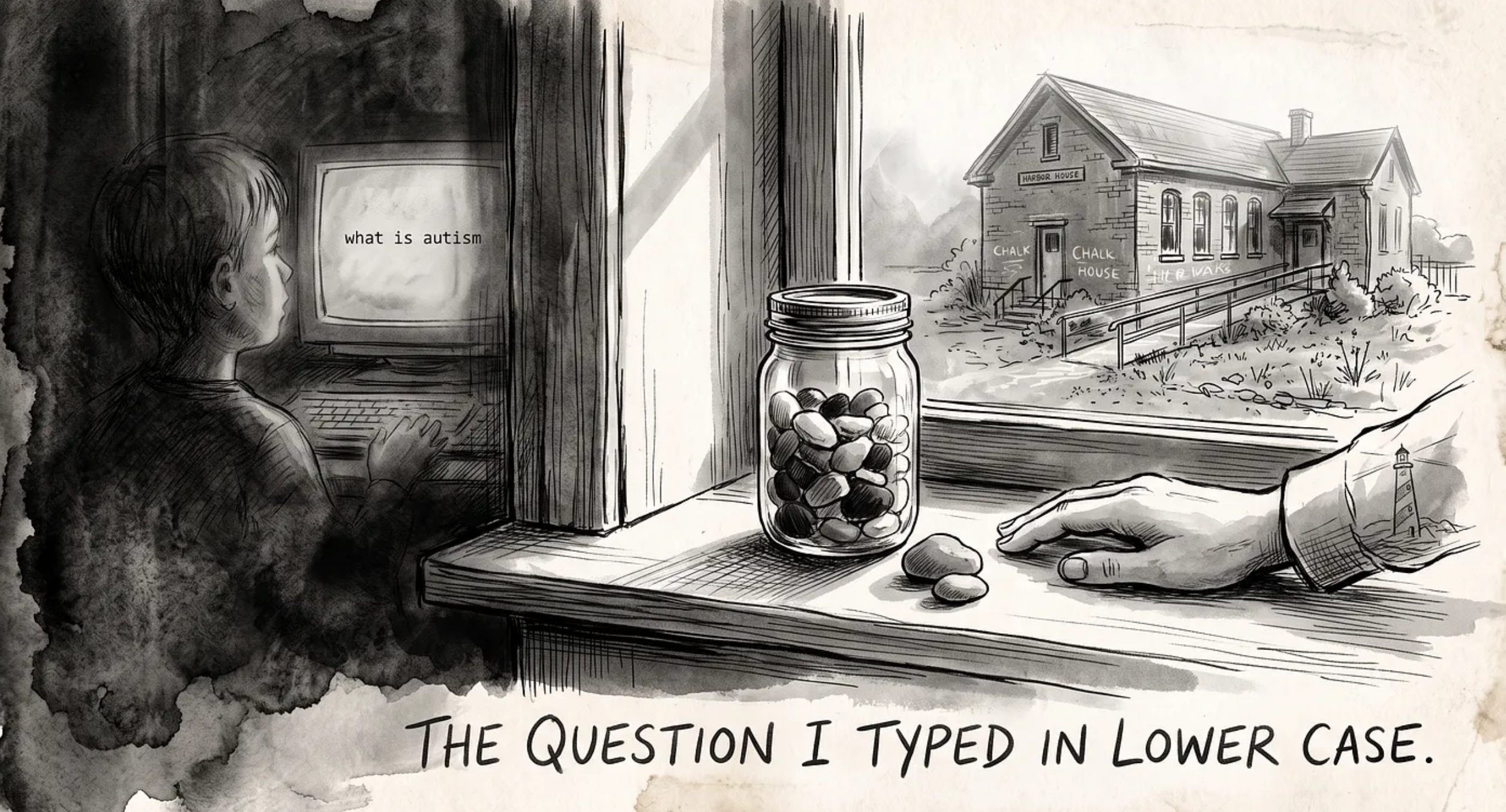
I was nine when I typed what is autism into the family computer.
Lower case. No question mark. I wasn’t sure I was allowed to ask it.
That summer my sister June stopped answering to her name. She started carrying stones up from the driveway and laying them along the porch, lightest to darkest, all the way down to the step. Our parents called it a phase.
I thought it was a language. I thought nobody had offered to teach it to me.
The screen gave me a page of grey text with the word disorder in it four times. I closed the window before anyone came into the room.
Twenty-five year later
Twenty-five years later I was thirty-four, out of a lease, and on a night bus going north with a cardboard box on the seat next to me.
Our mother’s things. A library card. A jam jar of June’s stones that had stood on her windowsill for two decades without any explanation ever being offered. And a flyer, gone soft from folding, for a place called Harbor House.
On the back, in her small handwriting: New program. You should go see.
She wrote it. She didn’t go. Then she died, and I inherited an errand.
Harbor House
Harbor House was not a clinic. It was an old brick schoolhouse with a chalk-covered ramp and a garden where nothing was planted in rows.
“I’m not a parent,” I said at the desk. “I’m just her brother.”
“We get a lot of brothers,” said Lena, who runs the place. She said it the way you’d read out a delivery time. No warmth in it, no judgement either.
June was twenty-six by then. A supported flat four streets away, mornings at a bakery, and she still sorted things while she was thinking. She knows everyone’s birthday without writing it down. She watches your mouth when you talk, because eyes, she says, are too loud.
I came to hand over the stones. I stayed for tea.
The Thursday Library Group
On Thursdays a group met in the library. The sheet on the door said autistic adults, drop in, no forms.
I stood in the corridor and listened for ten minutes before I went in.
A man in his forties said he had spent thirty years assuming he was simply bad at being a person. A woman said she had found out at thirty-eight, after her daughter’s assessment.
I was waiting for her to say it had made her life make sense. She didn’t.
“People expect you to cry,” she said. “I was mostly tired. I’d already done all the work of coping on my own. Nobody hands that back to you.”
I recognised more than I wanted to. The scripts I write out before I phone the bank. The lighthouse I have drawn maybe forty times, the same lighthouse, until the line is right. The hour I need in the dark with nothing in it after a full day of talking.
I said none of that. I drank the tea and went out to the garden.
Samir
Samir turned up in March with a laptop and a two-year-old who would not sleep.
He had found something called a cubby bed. A small enclosed bed with a canopy, the kind of thing some families use to make the night smaller and quieter and safer. He had been trying for four months to get it covered.
There was a form. Then a form for the form. Then a phone number that rang for eleven minutes and cut out.
Lena took a binder from the cupboard and called the occupational therapist with him sitting right there, so he didn’t have to sit alone with it.
That was most of what Harbor House did, I started to see. Not therapy. Company for paperwork.
One rainy afternoon
One rainy afternoon Lena was emptying the bottom drawer of a filing cabinet and asked me to help.
She pulled out a stack of glossy pamphlets from 2012. One had high functioning autism across the front, above a photograph of a boy at a window.
“That term was never in the manual,” she said. “It went round anyway. It made people believe that if you could talk, you were fine. Support needs move. Some days more, some days less.”
Underneath was a handwritten sheet. Someone had put level 1 next to one name and level 2 next to another.
“Those come from the diagnostic manual,” Lena said. “Level one, needs support. Level two, substantial support. Level three, very substantial. It isn’t a score for how autistic somebody is. It has nothing to do with how clever they are. It’s a note about what makes a day workable.”
June was at the table taking the staples out of the old pamphlets, because she likes the sound.
“I was a two when I was nine and the supermarket was too bright,” she said. “Mostly a one now. Tired weeks, two again.” She dropped a staple in the tin. “The paper doesn’t move as fast as I do.”
Milo, her housemate
Her housemate Milo came by that evening to borrow the hose. Milo knows every bus timetable in the region and is very funny on purpose, which people keep missing. His file says level three.
I had expected that to mean something enormous. It means he needs a lot of support with change and with loud rooms. It does not mean he needs help being watered.
I showed him the new fitting, hand over hand, then let go. He watered the entire garden, including my shoes, and then looked at me for slightly too long, which is how Milo laughs.
The internet at night
At night I fell into the internet.
is autism genetic, at 1:14 in the morning. what causes autism.
The calmer sites were less dramatic than the forums. Genes matter a great deal, but not one gene — a lot of them, working with early development. It runs in families more often than chance would give you.
I thought about our grandfather, who built the same model boat over and over, and who used to stand in the garden during parties.
And the causes people shout about loudest are the ones that were checked and ruled out long ago. Not vaccines. Not cold mothers. Biology and development, tangled together, nobody’s fault. Which turns out to be the hardest part.
I asked June about it over dinner.
“Do you think Mum knew? That it was in the family?”
She was sorting my forks by length. “Mum thought Grandpa was particular.” She put the small one at the end. “Maybe we’ve got a lot of particular.”
Printing schedules
A week later I was printing visual schedules at the public library and found that whoever used the terminal before me had left their search history open.
One line read: does that streamer have autism.
I looked at it for a second. Then I cleared it, because it wasn’t mine, and it wasn’t the streamer’s either, being guessed at by a stranger at a public computer. Whether a person is autistic belongs to that person, to say or not say.
I understood the impulse. It’s the same one that made me type a question in lower case at nine years old.
You look hard at somebody else so you don’t have to look straight at the thing.
Blue posters
In April the shops put up blue posters. A student came round with flyers for a walk organised by a large national charity.
“Not on this board,” Lena said, pleasantly enough. “That group raises a lot of money. A lot of the autistic people who come here have felt talked about by it rather than talked to. This board is for people who are in the room.”
She pinned up her own sheet next to the empty space: April is autism awareness month. We are open the other eleven too.
The student stayed for tea anyway. She came back in May.
What about Autism
A teacher stopped me in the corridor of the high school to ask about autism. Her father was given the diagnosis in 2008. Her son was given an autistic spectrum diagnosis last year. She wanted to know whether they had the same thing.
I told her what I’d been taught, carefully, because it wasn’t mine to decide. That they were several separate categories once. That in 2013 everything was folded into autism spectrum disorder.
“Plenty of people still use the older words for themselves,” I said. “It was theirs for a long time. Other people are glad to see the back of it. I don’t mind”
“So which is right?”
“Ask your father,” I said. “Then ask your son, in a few years. They might not match.”
Fourteen months after I asked for it
My own assessment came through in October, fourteen months after I asked for it.
It wasn’t a quiz. It was two mornings of talking. Childhood. School reports our mother had kept. The stones. Bus brakes and phone scripts and lighthouses. Whether I eat the same lunch every day, and for how long, and what happens when the shop stops stocking it.
Nobody gave me a number to hang on the wall. I got a document with my name at the top, a diagnostic code in the third paragraph, and a page at the back about what I could now apply for.
I read the back page twice and the rest of it once. Then I put it in the drawer with my lease and my passport, which is where it belongs, being a piece of administration rather than a personality.
Nothing about my life changed that week. I still need the hour in the dark.
The difference is that the hour has a form number attached to it now, and a form number is a thing you can hand to an employer.
On the kerb outside
June was sitting on the kerb outside my building that evening. She walks at night, when there are fewer cars and fewer faces.
“Did you find out what is autism?” she asked, and kicked a pebble along ahead of her.
The question off the family computer. Twenty-five years late, and arriving in her voice instead of mine.
“I think I was asking it wrong,” I said. “I thought it was a stone you carry around. It’s closer to how the whole thing is tuned. More detail, more pattern, more light and sound coming in. Less filter on the way through.”
She thought about that the way she thinks about everything, which is properly, and slowly, and without hurrying to agree with me.
“And sometimes you need a bed with a roof on it,” she said. “And a garden with no rows.”
We walked up. The jam jar was on the windowsill where the north light comes in flattest and stays longest, which is why painters want that side of a building, and which is why June chose that sill without ever being told anything about painters.
She had added two new stones that week.
Both grey. Almost the same.
Not quite.


