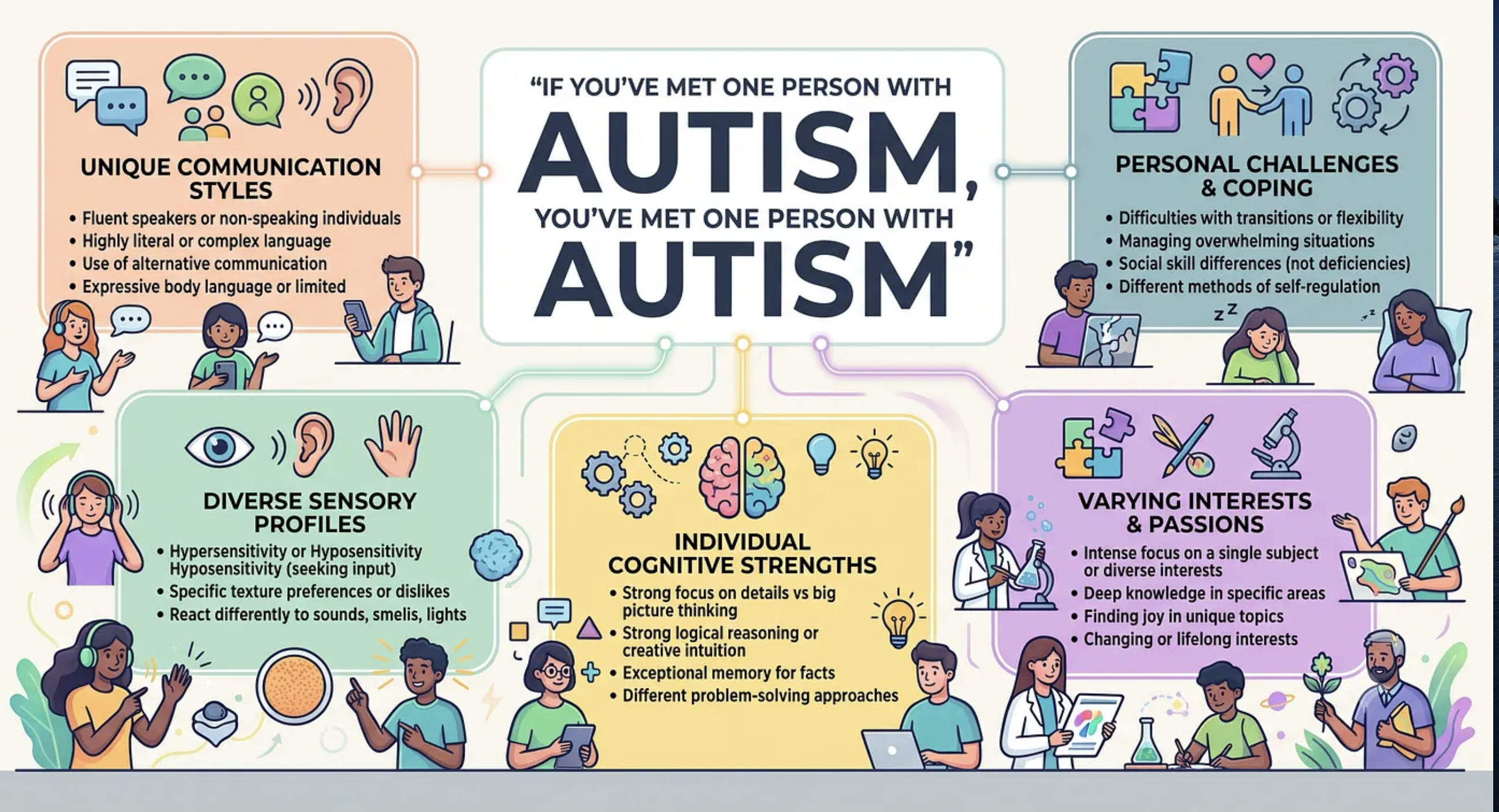
In short: While the famous autism quote may counter stereotypes, using it may erase shared struggles and gives society an excuse to change nothing.
You hear it often at conferences, or you read it in books and blogs about autism: “If you’ve met one person with autism, you’ve met one person with autism.” The American researcher Stephen Shore once said this, and today it is probably the most used sentence in the autism world.
At first glance, it makes perfect sense. Nobody would meet one person in a wheelchair and claim they know exactly how all people with a physical disability live. But with autism, this happens all the time. This famous quote is meant to protect us from being put in boxes. However, if we look closely, we can see that this sentence is sometimes a trap. It can even stop a good conversation.
Why is this sentence so important, and where does it go wrong?
The Power of the Quote: Seeing the Unique Person
This statement was created to break stubborn stereotypes. That was, and still is, very necessary. Sometimes people think you cannot be autistic because you are married, have a busy job, or talk easily. Or they assume that every autistic person only talks about trains and has no sense of humor.
But autistic people are incredibly different. The variation in how autism shows itself is huge:
- One person needs a lot of daily help, while another lives and works independently.
- One person speaks very easily, while another uses no spoken language at all.
- One person looks for many social contacts (and gets exhausted afterwards), while another prefers to spend a lot of time alone.
Even when behavior looks the same, the reason behind it can be different. Someone might be quiet because the room is too noisy, because the information is coming too fast, or simply because they have nothing to say at that moment.
The quote protects us from quick judgments. It says: look at me as a unique person. Do not judge me based on how someone else happens to react.
Why this Quote Can Hurt
Still, a problem arises when we use this sentence too often. If we keep repeating that everyone with autism is completely different, what does the word ‘autism’ even mean?
There are patterns that we share. Many autistic people struggle with unexpected changes, get overstimulated quickly, or find unwritten social rules confusing. The way our brains process information — the medical and biological base — is largely shared. If we shout that everyone is unique just to avoid stereotypes, we forget the real, medical vulnerabilities that come with the diagnosis.
Besides that, we need each other. Many autistic people find peace and understanding with peers. When we talk about feeling exhausted after a workday, we share an experience. If we put too much focus on how unique we all are, we take away that connection. In the end, it just makes us feel lonely again.
A Handy Excuse to Change Nothing
The biggest danger of this quote is that society can use it as an easy excuse. An employer or a school director might say: “Well, everyone with autism is apparently different, so we cannot make general rules.”
Because of this, a company does not have to change its noisy open-plan office or its unclear communication. The problem is completely pushed onto the individual. You have to prove again and again why you need changes. Meanwhile, we know that basic rules — like clear communication, predictability, and a quiet workplace — make a positive difference for almost every autistic person.
The Irony: How the Quote Creates New Stereotypes
It is actually very ironic. A quote that was made to break stereotypes often leads to new stereotypes in real life. This happens in three ways:
1. The idea that autism is an impossible mystery
If you keep repeating that everyone is fundamentally different, people quickly think that autism cannot be understood at all. A colleague or teacher might think: “If it is different for everyone anyway, there is no point in trying to learn about it.” This takes away people’s motivation to learn the basics.
2. Shared struggles are seen as complaining
If someone says they struggle with typical autistic sensitivities — like loud noises or unexpected plans — the people around them might react: “But your autistic colleague doesn’t care about that at all. So it is just you.” The real patterns that we share are suddenly brushed off as personal complaining.
3. The myth of explaining everything yourself
The quote forces people to look at the individual, but it wrongly assumes that every autistic person can perfectly explain what they need. For someone who does not speak, has an intellectual disability, or is simply too tired to give explanations all the time, this is very hard. People often think: if you do not ask for help yourself, everything must be fine.
A sentence that was supposed to free us from stereotypes, sometimes gives us the new stereotype that autism is just a random mix of personal quirks.
A New Balance: Between Theory and Practice
How should we deal with this? The answer lies in finding a good balance.
We need the medical view: we must dare to admit that there are clear, shared patterns in how we process information. At the same time, we need to look at our environment: how does a busy workplace or unclear communication stop us, and what do we need as individuals to function well?
We do not have to choose between ‘everyone is the same’ and ‘everyone is totally different’. We need basic knowledge to understand autism, but we must also keep looking at the person in front of us. Maybe we should change the famous quote just a little bit:
What you learn from one person with autism doesn’t tell you everything about autism. But it doesn’t tell you nothing, either.
See general knowledge about autism as a dictionary or a grammar book. You need to know the words and the rules to read the language. That is your base. But after that, you must always keep listening to the unique story the person in front of you is trying to tell with those words.
This article first appeared, slightly different, on my Medium.com blog.


