On a good day, I can talk a lot. Sometimes, I talk more than is good for me. I have learned to make an effort, choose my words carefully, and leave a good impression.
The message has always been clear: do not look foolish. Do not make other people uncomfortable. Control your reactions. Fit in.
At school, and later in support services, I learned to hide parts of myself. The aim often seemed to be that other people should notice as little as possible.
So I watch myself. I think about my posture, my movements, my clothes, and my personal care. I study my voice: its speed, its tone, and its sound. I consider what to say, when to speak, and when to stay silent.
You see the conversation. You do not see all the work that makes it possible.
What looks natural from the outside may take a great deal of thought and energy.
Fitting in is not the same as feeling safe
I do not do this because I enjoy it. I am not trying to win praise or get my own way.
I do it because I fear what may happen when I act differently.
An unexpected movement, an unusual sound, or a direct answer can change how people treat me. Some people are quick to judge behaviour they do not understand. They may call it strange, rude, or stupid.
Even people who describe themselves as open-minded can make me feel that there is only one acceptable way to behave.
To protect myself, I try not to be fully myself.
That is painful. It creates stress. It does not remove my difficulties. Sometimes, it only helps me avoid something worse.
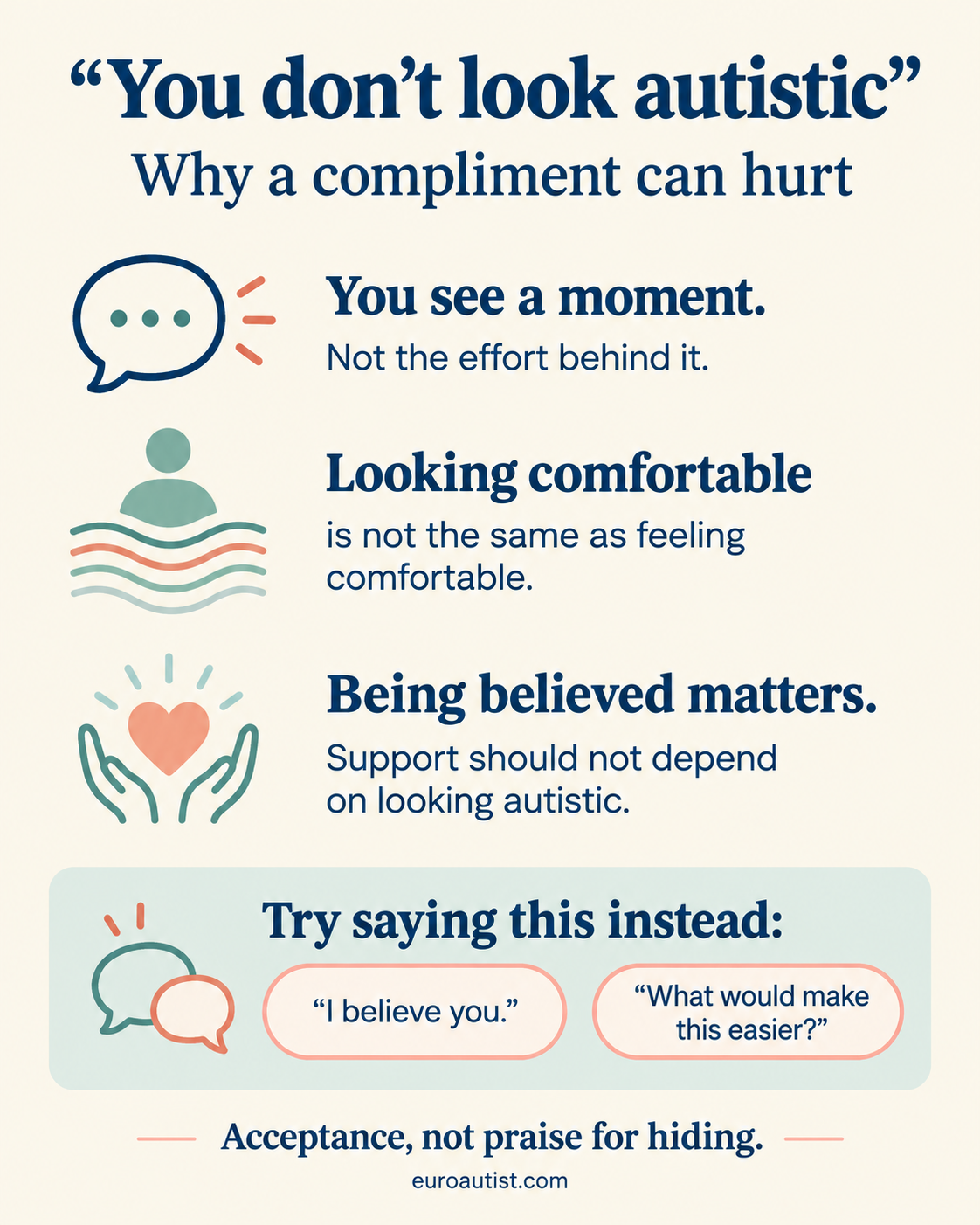
Looking comfortable is not the same as being comfortable.
When people doubt what they cannot see
Despite this effort, I have often faced doubt rather than understanding.
I remember lying on an operating table while a surgeon made jokes about people who called themselves autistic. He described them as rude and lazy. I was there, listening, while he spoke over my head.
I have also seen professionals question or change the description of my diagnosis without properly knowing me. This happened even though a specialist team had already assessed me.
Sometimes, my doctor would ask whether I “still” had autism. I felt like answering: “Not between 5 and 10 November, doctor. But the rest of the time, yes.”
The humour hides a painful point: I was being asked to prove something that had already been carefully assessed.
At an appointment with a job-coaching service, a staff member first refused to record that I was autistic. She asked whether I had found the idea on the internet. When I challenged what she wrote instead, the conversation became hostile.
These experiences matter. They are part of the reason why a small comment can carry so much weight.
The problem with the “compliment”
Then someone says:
“But you don’t look autistic.”
Perhaps they mean that I speak clearly. Perhaps they find me friendly. Perhaps I do not match the picture of autism in their head.
But I do not hear simple praise.
I hear that my experience is difficult to believe. I hear that the effort I make has hidden the very difficulties for which I need understanding.
The comment also leaves me wondering: what does this person think an autistic person should look like?
When someone says I have “only a little autism”, they are judging me from the part they can see. They do not see everything I hold back. They do not know what the interaction costs me.
The fact that you cannot see my difficulties does not mean that I am not experiencing them.
If someone appreciates my words, my humour, or my ideas, they can say so. There is no need to turn that praise into a statement about how little autism they notice.
Please do not turn me into someone else’s promise
Sometimes, a person tells me that I give them hope for their autistic nephew or another family member.
I understand the wish behind this. They care about someone and want that person to have a good life.
But it hurts when I am treated as proof that an autistic person might one day appear less autistic.
My life is not a promise about another person’s future. A short conversation with me does not show all the support I need, all the difficulties I face, or all the effort behind that moment.
I would rather be met as a person than used as a hopeful example.
Support should leave room to be yourself
I value meeting other autistic people who want to share experiences. There is something important about being able to talk without having to prove yourself.
But shared experience does not automatically make one person an expert on another person’s life.
I become uncomfortable when support turns into another lesson in how to behave correctly. I do not need another person telling me which parts of myself should disappear.
I want room for different ways of living and taking part in society. That does not have to mean paid work. It should not have to mean looking as similar as possible to everyone else.
What I would rather hear
I do not always have the energy to explain why a comment hurts. Sometimes, I can start that conversation. Sometimes, I need to protect what energy I have left.
What I want is acceptance, not praise for hiding myself.
I would like to walk in my own way. To move my body without fear of being judged. To speak without constantly checking my voice. To avoid eye contact when it makes an interaction harder for me.
Instead of “You don’t look autistic”, I would rather hear:
“I believe you.”
“Is there anything that would make this easier for you?”
Or simply:
“You can be yourself here.”
I do not want to be accepted only when my autism is difficult to notice. I want to be accepted as a whole person, without having to hide so much of who I am.


