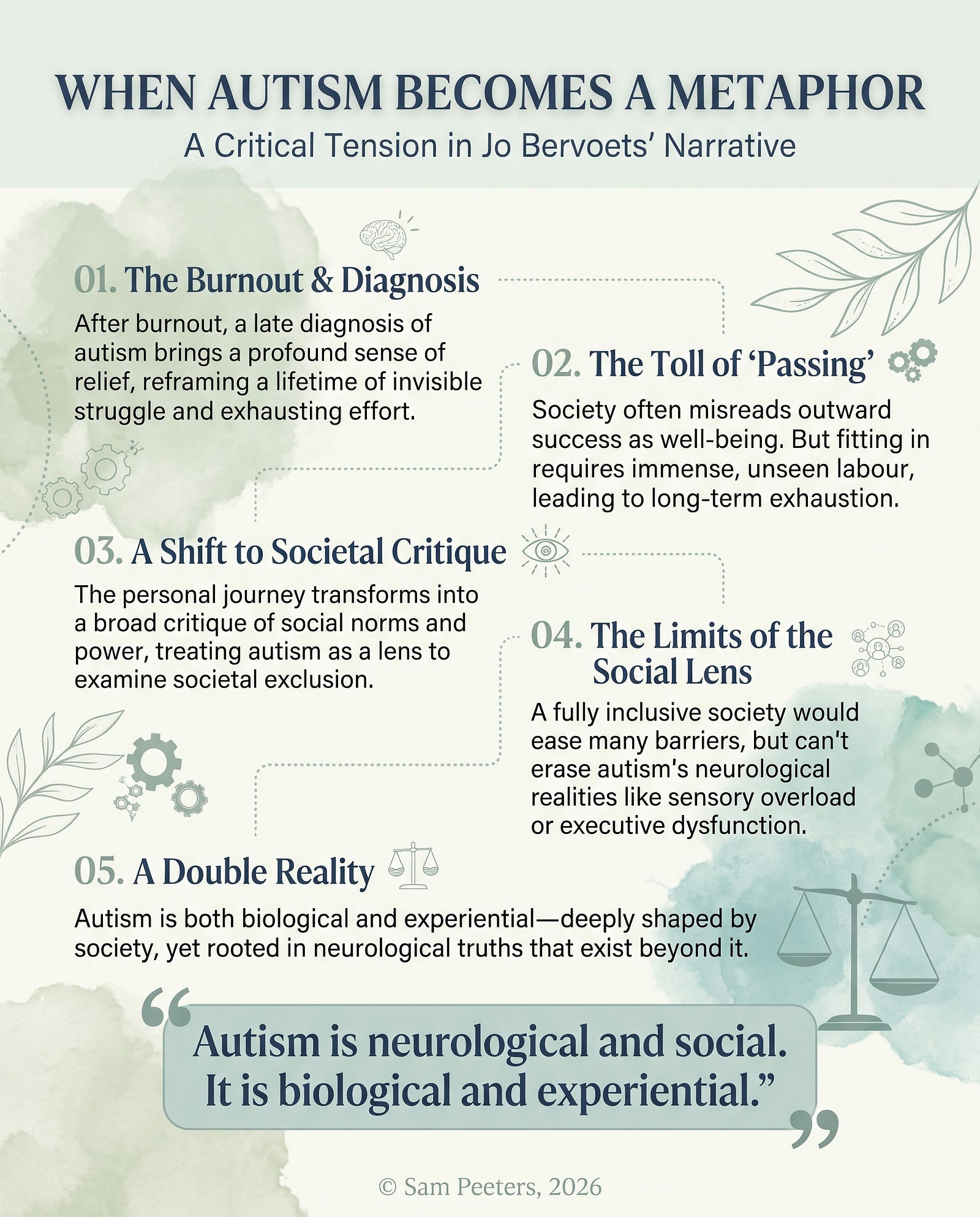
What begins as a compelling account of autistic awakening — illuminating exclusion and masking — risks reducing autism to a social condition rather than a neurological reality. I recently read the Flemish philosopher and Tilburg University assistant-professor Jo Bervoets’ latest essay, I Am an Enlightenment Apostate. Some of you may recognise his name from one of my earlier posts on this blog.
The Late-Diagnosis Turning Point
His essay opens in a space that will feel familiar to many late-diagnosed autistic adults.
After a long career as an engineer, he burns out. Sitting in a psychiatrist’s office, he is confronted with the possibility that he is autistic.
Looking back, experiences that once felt disconnected suddenly form a coherent pattern for him: the exhaustion, the feeling of being different, the constant effort to adapt, and the sense that life somehow demanded more energy from him than it seemed to demand from others.
Challenging the Myth of Success
It is a powerful narrative because it challenges one of society’s most stubborn myths: the assumption that visible success reflects how well someone is doing. Degrees, careers, and professional achievements often conceal struggles that remain invisible, even to those closest to us.
What appears to be competence is often a highly sophisticated form of compensation. What appears to be resilience is often prolonged exhaustion.
Belonging to a Minority
Bervoets captures this dynamic vividly when describing the realisation that he belonged to a minority, despite having spent much of his life appearing to belong to the majority. The concept of minority status seemed to shock him — and, reading between the lines, it still appears to do so:
“I realized I also formed a part of a… minority.”
Reframing Personal Struggle
For many autistic adults, especially those diagnosed later in life, that shift in perspective can be profound. Difficulties previously interpreted as personal failings to be overcome through future effort suddenly take on an entirely different meaning.
The problem was not a lack of effort; in many cases, it was precisely the opposite: too much energy expended trying to conform to someone else’s definition of normal. That insight is arguably the strongest part of his essay. It also means that Bervoets realizes his growth potential is not as big as he thought it to be.
The Energy Cost of Passing
Bervoets describes autistic life as demanding
“additional energy required to pass”
to meet the expectations of those around him. Whether or not one agrees with every conclusion he draws from that experience, the observation itself warrants serious attention.
Too often, discussions of autism focus exclusively on what can be observed, overlooking the vast amount of invisible labour required to appear unaffected. Some autistic individuals become experts in self-monitoring — suppressing behaviours, deconstructing social dynamics, and continuously adjusting to expectations that never feel intuitive. The cumulative toll of that effort often only surfaces years down the line.
From Personal Diagnosis to Societal Critique
Yet, as the essay unfolds, something shifts. Autism gradually changes its function within the narrative. At first, autism serves to make sense of a personal history. Then it becomes a vehicle for understanding minority experiences more broadly.
Ultimately, it evolves into a sweeping critique of dominant epistemologies, social norms, and established notions of rationality. What began as a personal reflection on autism expands into a critique of society at large.
Autism as an Epistemological Lens
This pivot is understandable. Discovering that one belongs to a minority frequently alters how one perceives other forms of marginalisation. The experience of failing to fit comfortably within dominant paradigms can foster an acute sensitivity to perspectives historically ignored or dismissed.
In that sense, autism ceases to be merely a diagnosis and becomes an interpretative lens. The critical question is what happens when that lens becomes the singular explanation.
Explaining Autism Versus Society
Throughout the essay, I found myself returning to a fundamental question:
Is the author explaining autism, or is he using autism to explain his worldview?
The distinction is crucial, as the two are not interchangeable — a conflation that is increasingly common in contemporary writing on the topic.
The Reality and Limits of Social Norms
A substantial portion of the essay centres on exclusion, adaptation, recognition, and power dynamics. Autism is framed primarily as an experience of being coerced into conforming to externally imposed norms.
There is undeniable truth to this: social expectations unquestionably shape autistic lives. Demands regarding communication style, eye contact, productivity, relationships, and emotional regulation place immense pressure on those wired differently.
Yet there comes a point where autism risks being treated almost entirely as a social construct. The issue is not that social explanations are incorrect; it is that they are inherently incomplete.
Persistent Biological Realities
Even within a radically accommodating and inclusive society, most autistic individuals would continue to face challenges that cannot be resolved solely through social acceptance or mutual understanding.
Sensory overload would remain. Executive dysfunction would remain. Differences in communication, disrupted sleep patterns, intolerance of uncertainty, and cognitive rigidity would all persist. An accommodating society can alleviate unnecessary suffering, dismantle external barriers, and substantially improve autistic lives, but it cannot legislate autism out of existence — and framing it purely socially risks minimising the profound physiological burdens many experience.
Displacing the Neurological Core
This highlights the central tension running through the essay. The more energy devoted to arguing that society alone produces disability, the less attention remains for the underlying neurological realities that made the diagnosis necessary in the first place. Autism is gradually pushed from the core of the narrative to its periphery, leaving society as the primary protagonist.
The Perspective of High Achievement
This divergence becomes even clearer when considering the specific vantage point from which the essay is written. Bervoets writes from the perspective of someone who navigated higher education, built a sustained professional career, and completed a doctorate.
He rightly challenges the assumption that conventional markers of success equate to well-being; a high-achieving life can still be deeply distressing, and outward accomplishment rarely reflects the internal cost required to sustain it.
Voices Left Unrepresented
Nonetheless, his trajectory represents a very specific position across the vast autism spectrum. Most autistic individuals never have the opportunity to build an unassisted career. Most lack the capacity to mask for decades.
Most require ongoing, substantial daily support, or grapple with challenges around non-speaking communication, independent living, and adaptive functioning that cannot be framed purely through identity, recognition, or systemic social exclusion. Their absence from this framework is conspicuous.
The Limitations of Individual Experience
This is not to say that Bervoets is obligated to speak for everyone, but rather that his personal experience is treated as a foundation for universal claims about the nature of autism.
The version of autism presented here is largely that of a highly articulate, intellectually privileged adult who discovered relatively late in life why social adaptation had been so exhausting. That perspective is undoubtedly valuable, but it does not represent the entirety of the spectrum.
Standpoint Knowledge and Its Boundaries
A parallel issue arises in how the essay approaches knowledge and authority. Bervoets argues that marginalised individuals hold unique insights routinely dismissed by dominant groups.
This holds significant merit: for decades, autistic people were spoken about rather than listened to, and the rise of autistic self-advocacy has exposed critical blind spots in both clinical practice and public policy. However, lived experience alone has its limits.
Internal Disagreements and Subjectivity
Autistic individuals disagree fundamentally about the nature of autism. A minority conceptualise it primarily as a culture or identity; others experience it predominantly as a debilitating condition. Another group, somewhat larger, advocate strictly for accommodation, while others pursue clinical interventions and therapeutic support. Very few embrace neurodiversity terminology, while most of the autistic community find that it trivialises the severity of their impairments.
Each of these viewpoints stems from genuine lived experience. Consequently, phenomenology alone cannot define autism’s full ontological reality. Lived experience articulates what autism feels like from the inside; it does not provide an exhaustive scientific or conceptual account of what it is.
Concrete Reality Versus Philosophical Metaphor
It is on this point that my view departs most clearly from the essay. The text is at its most compelling when it remains grounded in concrete realities: autistic burnout, masking, the relentless labour of adaptation, and the hidden costs of external success.
It becomes far less persuasive when autism is abstracted into a philosophical metaphor. The further the argument drifts from somatic and clinical reality, the harder it becomes to tell whether we are gaining insight into autism, or merely using autism as an incidental vehicle to critique broader social structures.
The Paradox of the Social Lens
Ultimately, the essay’s primary strength and its primary vulnerability share the exact same origin. Its value lies in demonstrating that autism cannot be evaluated in isolation from the social environment. Its weakness lies in implying that autism can be comprehensively explained by it. The actual reality is considerably less tidy than either extreme suggests.
Beyond a Single Story
Autism is simultaneously neurological and social, biological and experiential. It manifests variably as an identity, a disability, or both. It is profoundly mediated by society, yet it cannot be reduced to a mere social construct. It carries innate friction that societal exclusion certainly amplifies, but by no means solely invents. What Bervoets articulates is a vital piece of the puzzle. The risk is not that his contribution is false, but that it is treated as the complete picture.
Autism, perhaps more than most facets of the human condition, stubbornly resists being captured by any single narrative.


