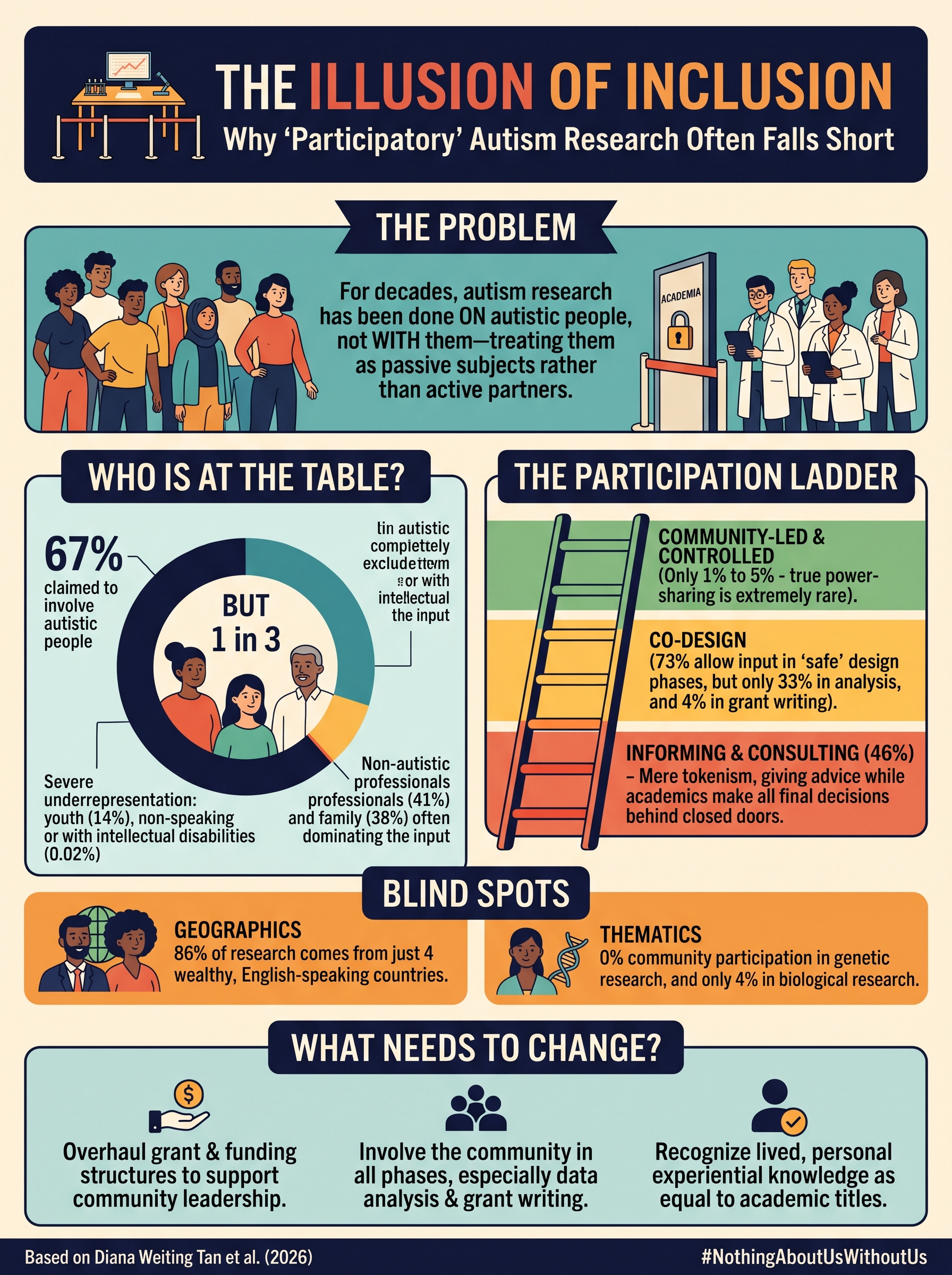
For decades, autism research was conducted without the people it is actually about. Autistic individuals were systematically reduced to passive research objects. This led to scientific insights that were often far removed from our daily reality and priorities.
Fortunately, the call for structural change has grown increasingly louder in recent years. The autistic community strongly advocates for ‘participatory research’. This is an approach where we do not merely serve as test subjects, but actively help steer the course of academic work as guiding partners.
The Rise of Participatory Research
A recent literature review by Diana Weiting Tan and colleagues (2026) meticulously mapped this emerging trend. They analyzed a total of 382 autism studies from the period 2001 to 2023 that claimed to actively involve the community.
The results paint a fascinating, yet painfully accurate picture. Participatory research is more popular than ever, but the pressing question remains: has the power dynamic in practice truly changed, or is this primarily a case of token participation?
Two Historical Traditions: Consultation versus Emancipation
To better contextualize the current situation, we must look at the roots of this movement. Participatory research essentially builds on two different traditions.
The ‘Northern tradition’ (US and UK, 1940s) focuses primarily on solving practical problems through consultation with the target group.
The ‘Southern tradition’ (Latin America and Africa, 1970s), on the other hand, has an explicitly political character. This tradition emphasizes that the marginalized community itself must be given absolute leadership and decision-making authority as a tool for emancipation.
Today, modern autism research unfortunately leans heavily on the pragmatic consultation culture of the first tradition, and rarely on the actual power-sharing of the second.
An Explosive Academic Trend
The growth of participatory autism research is frankly spectacular. Approximately 95% of this type of research took place in the past decade (2013-2023). Whereas only a single study with a participatory approach was found in 2001, this number exploded to 94 published studies in the year 2023.
This increase is the direct result of sustained activism. Through campaigns such as #NothingAboutUsWithoutUs, harmful research practices were openly criticized. The broader acceptance of the neurodiversity paradigm also played a role, as did the requirement from leading journals (such as Autism) to report on societal involvement.
Who is Actually Sitting at the Table?
The analysis shows that autistic individuals were genuinely involved in two-thirds (67%) of the studies. At the same time, this means that one in three studies proudly calling itself “participatory” simply excludes the autistic target group entirely.
Even when we are invited, representation is fundamentally unequal. The vast majority consisted of autistic adults (48%), while youth were consulted in only 14% of the studies. Even more distressing is the invisibility of autistics who speak little or not at all, or who have a co-occurring intellectual disability: they made up only 0.02% of those involved.
The Influence of Professionals and Family
Academics still lean extremely heavily on the input of non-autistic professionals (41%) and family members (38%). While their insights can be valuable, they often have entirely different—and sometimes directly conflicting—priorities than we do. The principles of ‘nothing about us without us’ require that autistic people hold the primary authority, with others playing only a supporting role.
Token Participation and the Ladder of Participation
To objectively measure the level of authority, the researchers used ‘Arnstein’s ladder of citizen participation’. The harsh reality is that the lion’s share of research remains stuck on the lowest, purely symbolic rungs. In 31% of cases, people were merely ‘consulted’ (giving advice, while researchers make decisions behind closed doors). Another 15% remained stuck at ‘informing’.
Projects where academic power was truly proportionally shared proved extremely rare. Community-led studies occurred in only 5% of cases. Fully community-controlled research amounted to barely 1%.
Where in the Process Are We Allowed to Weigh In?
Community members were most often allowed to weigh in during the study design phase (73%), which in practice mainly came down to rewriting surveys and interview schedules. But as soon as the formative decisions had to be made, the institutional door closed abruptly.
Only 33% were allowed to contribute to the complex data analysis, and in barely 4% were we allowed to participate in drafting the decisive grant proposals.
Autistics are therefore primarily utilized in the “safe” phases. As long as university-educated academics single-handedly determine how the collected raw data is interpreted, they retain absolute power over what counts as formal scientific truth.
Blind Spots: Geography and Thematics
There are massive blind spots. A staggering 86% of all identified studies originated from just four predominantly wealthy, English-speaking countries. As a result, culturally divergent and non-Western perspectives threaten to be completely marginalized.
Additionally, participation was almost exclusively applied to practice-oriented research (lifespan, interventions, services). Highly striking was the total absence (0%) in genetic research and the negligible role (4%) in fundamental biological research. While this very basic medical research has massive ethical implications for our right to exist, we are systematically barred from the laboratories here.
The Power of Identity-First Language
A fascinating finding was the hard statistical relationship between the level of participation and language use. Studies on the highest rungs of the participation ladder significantly more often (80%) used the community-preferred ‘identity-first language’ (e.g., “an autistic person”).
Studies that frantically clung to the purely symbolic advisory levels used the more medical ‘person-first language’ (e.g., “a person with autism”) in a staggering 84% of cases, which is experienced as belittling by many autistics. Genuine power-sharing clearly trickles down into a fundamental respect for the individuality of the autistic community.
A Critical Perspective from the Community
In daily practice, the academic growth trend of the buzzword “participatory” all too often feels like a cosmetic PR maneuver. We are politely invited to a one-off focus group, we are allowed to smooth out a wooden survey question, after which researchers triumphantly parade our “indispensable input” in their multimillion-dollar grant applications.
When the research becomes truly relevant and the data is translated into structural societal conclusions, the door to the meeting room locks again. This structural tokenism is paternalistic and belittling. It exhausts us mentally in the long run and causes a very real participation fatigue within our base.
Refusing Genuine Power-Sharing
Even more alarming is the lack of intersectional awareness and the institutional refusal to admit us as equal partners into the fundamental research field. The fact that non-speaking autistics are effectively rendered invisible conclusively proves that lab managers are merely looking for the “easy” autistics who fit smoothly into their neurotypical meeting schedules.
Why is the fundamental, moral authority over theories that directly concern our biological right to exist deliberately taken from us? Authentic participation is not a generous charity project. It requires the rigorous dismantling of the outdated idea that an academic, formal title inherently carries more weight than the wealth of knowledge from our lived existence.
Conclusion: Fundamental Systemic Change is Necessary
The final conclusion from Tan and her colleagues leaves nothing to be desired in terms of clarity: although the vocabulary surrounding participatory research has been widely normalized, actual, tangible emancipation and fair power-sharing still occur only as a very rare exception. Control remains firmly anchored in the hands of university institutions.
To truly make the leap to authentic, emancipatory research, a disruptive systemic change is necessary. Competitive grant structures, which discourage the relinquishing of leadership, must be fundamentally overhauled. The academic world must learn to acknowledge without reservation that lived experiential knowledge is a legitimate and indispensable source of hard scientific input. Only when decision-making power is fairly shared will autism research be able to transcend theory to meaningfully improve the quality of life of autistic individuals worldwide.
Tan, D.W., den Houting, J., Rabuka, M. et al. A comprehensive mapping review of participatory autism research over a 22-year period. Res Involv Engagem 12, 179 (2026). https://doi.org/10.1186/s40900-026-00998-y


