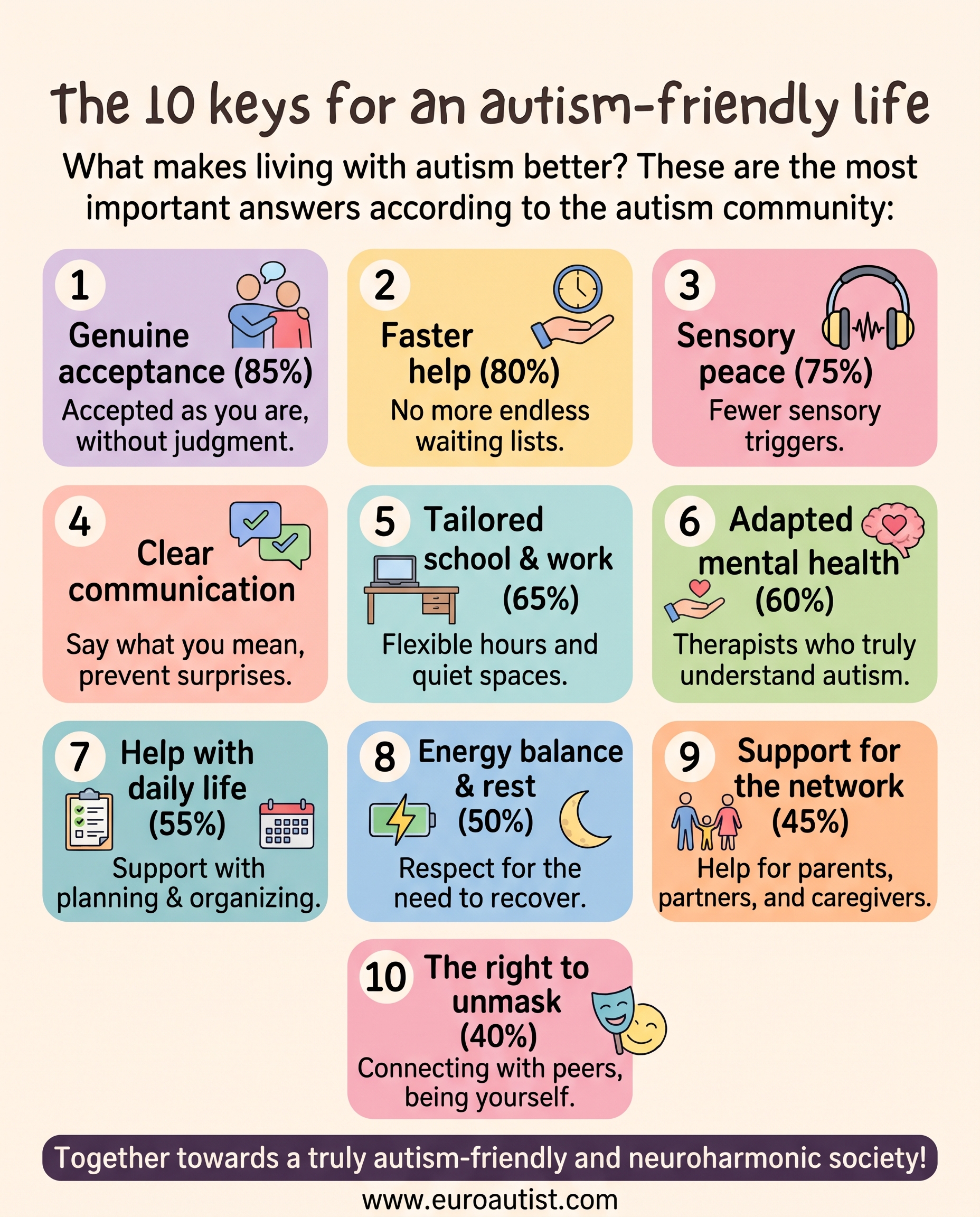
If you look at forums, social media, websites, and blogs, you will regularly find articles discussing the best ways to reduce the daily struggles that come with autism. While a minority of people would prefer to be “cured” of autism as quickly as possible—which is a whole different discussion—this article focuses on something else. Here, we present the top ten answers given by vocal autistic individuals on what would make living with autism more pleasant and autism-friendly.
The disadvantages and difficulties that often accompany autism usually arise at the intersection of a vulnerable neurological profile and an environment that does not accommodate it. Because of this, solutions are rarely about a “cure.” Instead, they are structural changes that remove daily friction and protect a person’s mental and physical energy.
Here are the ten most frequently mentioned solutions, ranked from most to least mentioned:
1. Genuine Societal Understanding and Acceptance (approx. 85%) At the very top of the list is not just “awareness,” but fundamental acceptance. There is a strong wish that autistic behavior—such as avoiding eye contact, communicating very directly, or “stimming” (natural movements to process sensory input)—is no longer seen as a defect that needs to be fixed. Being taken seriously and not being blamed or labeled as “unwilling” forms the absolute foundation for many.
2. Faster, Appropriate Help Without Endless Waiting Lists (approx. 80%) This is a highly practical pain point (and a well-known issue in regions like Flanders). Years of waiting lists for a diagnosis and the painfully slow process of getting support cause massive secondary damage. People want faster, affordable, and personalized help. They need a clear point of contact and continuous care, without having to reach a crisis point first.
3. Sensory Peace and Low-Stimulus Environments (approx. 75%) For many autistic people, sensory overload is a primary cause of chronic fatigue. The solution lies in “sensory hygiene” and actively reducing stimuli. This goes much further than just wearing earplugs; it involves structurally adapting living and working spaces. Think of soft, diffuse lighting instead of flickering fluorescent tubes, scent-free rooms, and having a quiet place to retreat.
4. Explicit Communication and Predictability (approx. 70%) Social interaction often drains an unfair amount of energy due to mixed signals and unspoken expectations. A major solution is clear, unambiguous communication. Say what you mean without hidden agendas, make concrete agreements, and announce changes in advance. Not having to guess what others mean drastically lowers the cognitive load.
5. Customization at School and Work (approx. 65%) This means letting go of rigid structures that force everyone to work in the exact same way. People ask for workable adjustments: flexible hours, the option to work from home, low-stimulus workspaces, and clear instructions. The goal is to create an environment where talents can shine without ignoring a person’s support needs.
6. Accessible Mental Health Care (approx. 60%) There is a great need for psychological and psychiatric help that truly takes autism into account. Support for anxiety, stress, depression, and burnout must be provided by therapists who understand how these issues can present differently in autistic people. At the same time, professionals should not automatically blame every mental health struggle solely on autism.
7. Support with Executive Functions and Daily Life (approx. 55%) When planning and organizing fail, concrete, practical help is needed. This means support with administration, household chores, and self-care. An effective method is to externalize the working memory: using visual step-by-step plans, checklists, or keeping a “done-list” to create peace of mind.
8. Recognizing the Energy Balance and Recovery Time (approx. 50%) Functioning in a neurotypical world drains a lot of energy. Keeping a strict “energy budget” is essential. This means scheduling rest, setting boundaries, and making room for “monotropic” focus: undisturbed time for personal interests and passions. This is not a luxury, but a crucial recovery mechanism to prevent an autistic burnout.
9. Care and Breathing Space for the Support Network (approx. 45%) This need is strongly voiced by parents, partners, and caregivers. Because professional help often falls short, a person’s own network absorbs the heaviest blows. Information, practical guidance, peer support groups, and respite care (the ability to temporarily hand over caregiving duties) are vital to prevent families from collapsing under the pressure.
10. The Right to Unmask and Connect with Others (approx. 40%) Constantly camouflaging how you truly feel to appear “normal” (masking) is exhausting. The solution lies for some in connection without the pressure to explain yourself: having contact with (autistic and other) people that enable building safe relationships where you can just be yourself. True acceptance means the forced need to act “normal” stops.
A Shared Responsibility When we analyze this top ten, we can see that the solutions are a combination of two approaches. On one hand, there is a call for individual care (diagnosis, guidance, coaching). On the other hand, there is a strong demand for more autismfriendliness and neuroharmony (fewer sensory triggers, clear communication, flexible education, and adapted workplaces, believe in each other’s strengths).
A large part of the autism community believes that the main problems stem from the impact of autism itself on body and mood as well as, but solely from the interaction between autistic traits and the way our society is organized. These priorities reflect the full reality: the acute need for good healthcare, carers and medical experts that listen and administrative simplification, combined with the demand for a society that structurally believes in an autismfriendly environment and neuroharmony rather than excluding people.


