What it really feels like when your brain refuses to guess what people mean
When I was ten years old, my teacher said: “Break a leg!” I froze. My leg? Why would she want me to break my leg before the school play? My mom laughed. “It means good luck, honey.” But I didn’t laugh. I felt angry. Because if she meant “good luck,” why didn’t she just say “good luck”?
I’m autistic. And I’ve spent my whole life listening to people say one thing while meaning another — then act surprised when I believe the words coming out of their mouths.
“I’m not literal because I lack imagination. I’m literal because the world keeps lying to me with a smile.”
The Problem Is Not My Brain
Let me be clear: I’m not broken. I understand metaphors. I get jokes. I know that “I’m dying” doesn’t mean death is coming.
What I do differently is this: When you speak, my brain doesn’t skip straight to your intention. It stops at your words first. It asks: What did you actually say? Is it true? Does it match what you mean?
Most people’s brains leap over this step. Your brain hears “I’m dying” and automatically translates to “I’m laughing very hard.” Your brain skips the dangerous, literal territory and lands safely on your intention. My brain doesn’t skip. It walks through the literal meaning, checks it, questions it, then — if the context gives me enough clues — moves toward what you probably meant.
It’s slower. It’s more careful. It’s exhausting.
Three Types of Phrases That Confuse Me
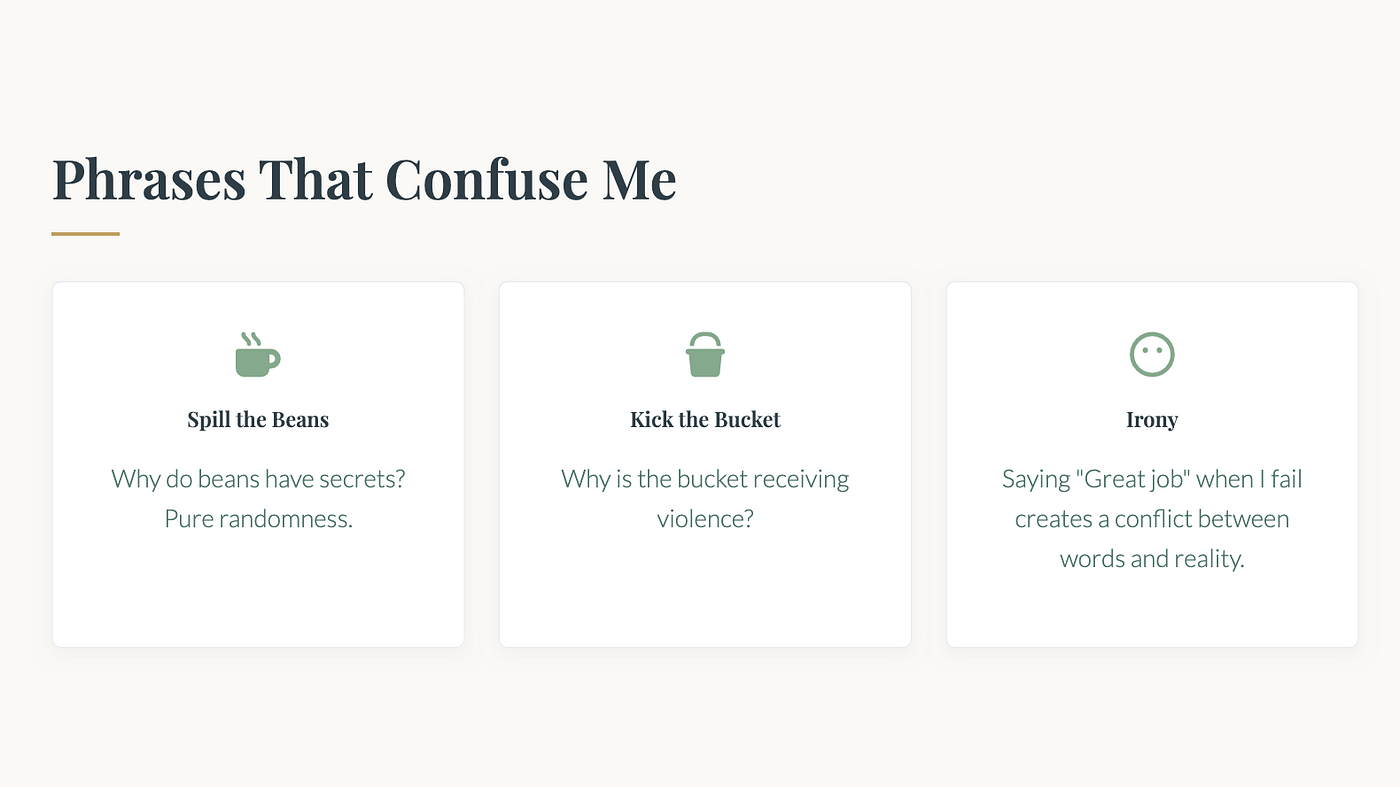
Opaque idioms: pure randomness
These are the worst: “Spill the beans”, “Kick the bucket”, “Let the cat out of the bag”.
Why would beans have secrets? Why is a bucket deserving of violence? With these phrases, there is zero connection between the words and the meaning. You can’t solve them with logic. You either memorized them, or you’re lost.
Metaphors: the slow dance between two meanings
“My father is a rock.” I know my father isn’t actually a rock. But my brain doesn’t immediately leap to “stability” the way yours does. Instead, I:
Notice: literal meaning doesn’t fit
Search: What do rocks have that fathers might have?
Find: hardness, stability, reliability
Decide: OK, that makes sense
You do all this in about half a second, unconsciously. I might need three to five seconds, and it feels like conscious work.
Irony: the cruelest form of lying
Irony is my enemy. Someone makes a small mistake, and I say: “Great job.” They laugh, assuming I’m being sarcastic. I’m not. I meant it.
Or worse — someone says: “Wow, you’re really on time today,” after I’ve arrived late. I believe them. Then I see their eye roll, and I realize: they were lying.
Why My Brain Works This Way
I don’t trust vague signals
Your tone of voice changes. Your facial expression shifts. Your posture says something different from your words. In a world where everything feels unpredictable, words are my anchor. They’re the only reliable thing.
My language skills are my strength — until they’re not
A word in the dictionary has a meaning. A clear one. If you use a word, you’re choosing that meaning. So when you say “break a leg,” I’m genuinely confused. The dictionary says break = damage, leg = body part. Why combine them?
Uncertainty feels unsafe
When I don’t know what you mean, I don’t feel intrigued. I feel scared. Confusion is not a puzzle to solve. It’s a threat signal. So I default to the safest interpretation: the literal one.
But Here’s What People Miss
I don’t just struggle with your figurative language. I make figurative language too — and sometimes it’s better than yours.
When I describe my own feelings, I don’t fall back on clichés: Not: “I feel sad” → “I have the blues”. Instead: “My chest feels like someone turned the brightness down. The air tastes gray.”
Because my brain doesn’t automatically reach for your metaphors, it has to build new ones from scratch. And that means I use words more precisely. More strangely. More truthfully.
The words you throw away as ‘just an expression’ are the ones I take seriously. And that’s why my metaphors hit harder than yours.
What I Need From You
I’m not asking you to stop using figurative language. I’m asking you to be fair.
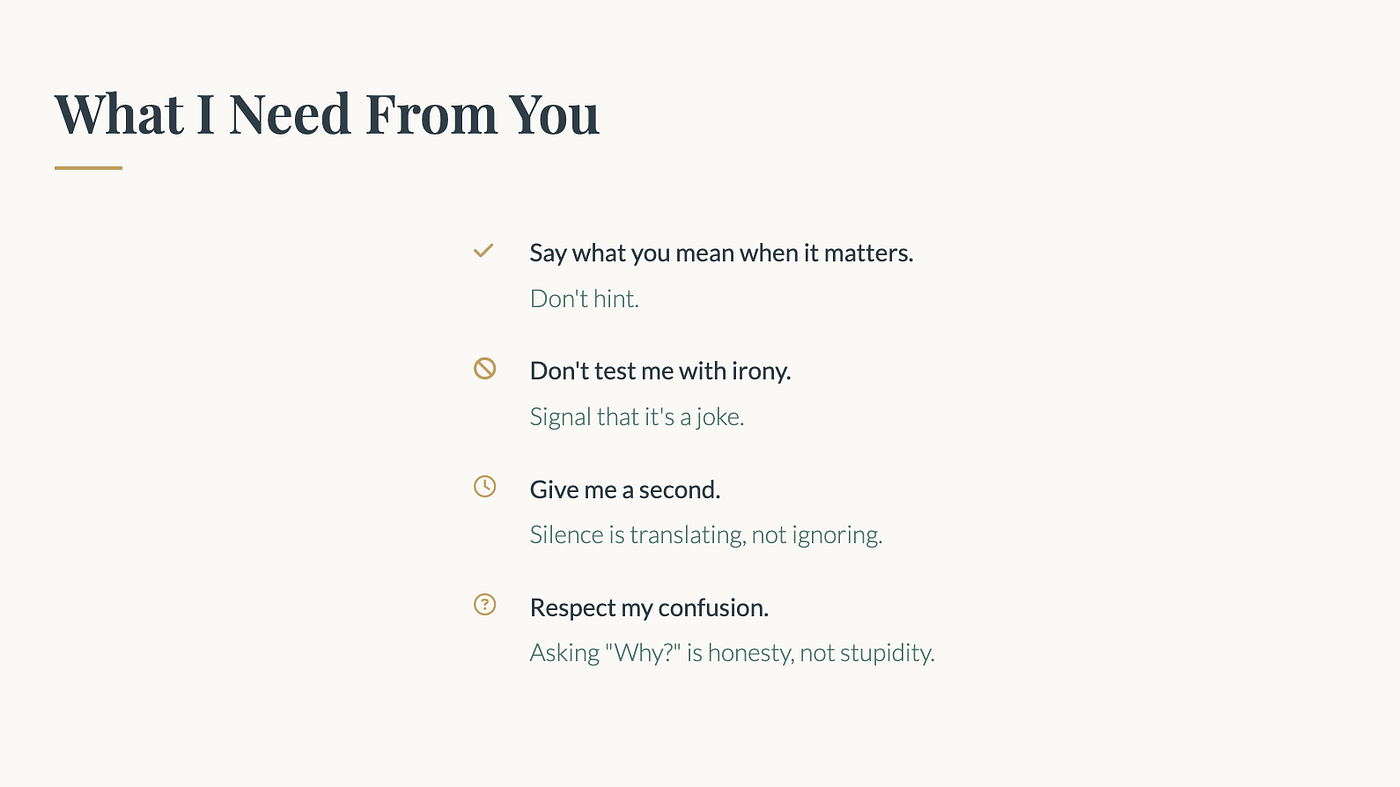
Say what you mean when it matters
Wrong: “Wow, you sure like to sleep in, don’t you?” Right: “I need you to wake up earlier tomorrow. It matters to me.”
Don’t test me with irony
When you use sarcasm to say something mean, and then act hurt when I take it literally, that’s not my fault. If you’re angry, be angry. If you’re joking, signal that it’s a joke.
Give me a second
When I go silent after you speak, I’m not ignoring you. I’m translating. My brain is processing the literal words, checking if the context supports a different meaning, and deciding if it’s safe to respond. That takes a few seconds.
Respect my confusion
When I ask “But why is a pity a bucket?” I’m not being stupid. I’m being honest. These phrases don’t make sense. You’ve just learned to ignore the nonsense and jump to the meaning.
The Real Translation
When I “take things literally,” what’s really happening is:
I’m refusing to guess. I’m insisting you say what you mean. I’m demanding that words match intentions.
In a dishonest world, that can look like a disability. But maybe — just maybe — it’s the most honest thing you’ll encounter all day.
So next time someone tells you they ‘take things literally,’ don’t pity them. Ask them what it costs to live in a world where nobody says what they mean.
My brain didn’t break language. Your language just refuses to be broken down into truth.


