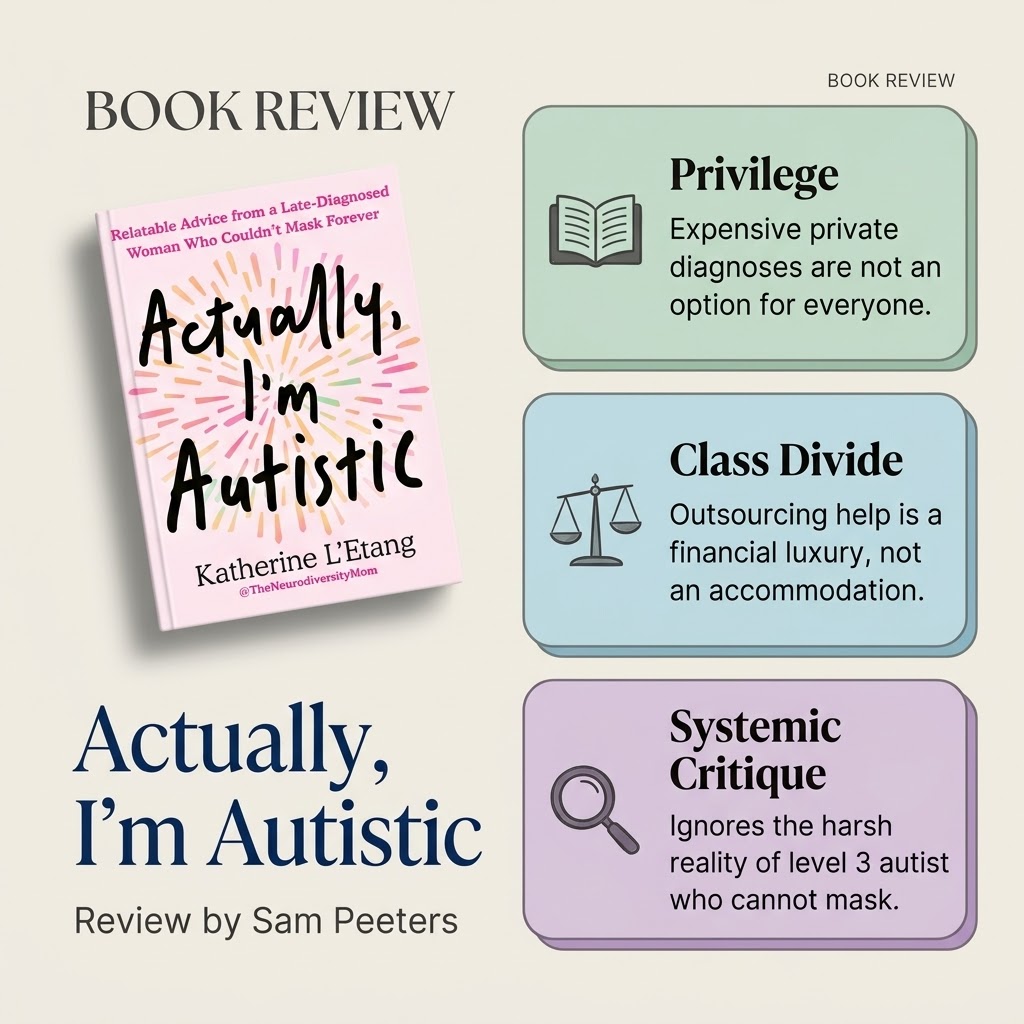
In Actually, I’m Autistic, Katherine L’Etang (known online as @TheNeurodiversityMom) promises to deliver “relatable advice from a late-diagnosed woman who couldn’t mask forever”. However, readers looking for a systemic, intersectional exploration of neurodivergence will find themselves sorely disappointed. Instead of a structural critique of an ableist society, L’Etang delivers a myopic, highly individualized narrative that reads less like universal autism advocacy and more like a catalog of upper-middle-class privilege masquerading as disability hardship. This North American, neoliberal approach to autism is not just unrelatable; it is structurally blind.
The Commodification of Diagnosis
L’Etang’s journey to self-discovery hinges on receiving her official autism diagnosis at the age of 31. How does she achieve this? By casually dropping $2,500 CAD on a private assessment to bypass public healthcare limitations. While she briefly acknowledges that paying for a diagnosis is a privilege, she immediately centers her own “suffering” by complaining about the agonizing one-month wait for her results.
For countless autistic adults across the globe languishing on multi-year waiting lists for public assessments, or those entirely priced out of the diagnostic industrial complex, her framing is tone-deaf. When your primary barrier to neuro-affirmative care is waiting a few weeks after writing a massive check, your diagnostic journey is a luxury, not a universal autistic struggle.
Capitalism, Burnout, and the Luxury to “Just Quit”
The book’s most glaring blind spot emerges in its discussion of autistic burnout and employment. L’Etang accurately notes that the unemployment rate for autistic adults can be as high as 80 percent. Yet, her personal engagement with this staggering statistic is entirely insulated by wealth.
When corporate life became too overwhelming, or when her entrepreneurial soap-making business pushed her toward burnout, L’Etang’s ultimate accommodation was simply to quit. She openly admits that she could afford to walk away from the workforce because her husband’s income was sufficient to support their family.
For the vast majority of the autistic community, quitting a job due to sensory overload or executive dysfunction does not lead to a cozy retreat into stay-at-home motherhood; it leads to poverty, eviction, and severe institutional trauma. Presenting “leaving your job” as a viable strategy for managing autistic capacity without thoroughly dismantling the capitalist structures that make survival impossible for marginalized autistics is deeply classist.
Buying Your Way Out of Executive Dysfunction
Perhaps the most out-of-touch advice in the entire memoir is L’Etang’s approach to managing the limited “spoons” (energy capacity) that come with an AuDHD (Autism and ADHD) profile. Her solution? Throw money at the problem.
To manage her household, she recommends “outsourcing” daily tasks: hiring a monthly cleaning company, paying for meal delivery kits, and utilizing wash-and-fold laundry services. This is not disability accommodation; this is buying your way out of executive dysfunction with sheer capital. Framing paid domestic labor as a casual “hack” for autistic burnout is an insult to the working-class neurodivergent people who are often the ones performing these low-wage services for wealthier individuals.
The “Chameleon” Narrative and Performative Intersectonality
L’Etang heavily leans into her identity as a “social chameleon” who survived by masking her autistic traits. To her credit, she admits that masking is a privilege that allows some autistics to pass as typical and access safety. She also dedicates space to warning against “Aspie supremacy” and briefly mentions the severe challenges faced by level 3 (high-support needs) autistics.
However, this intersectionality feels entirely performative when weighed against the rest of the text. She equates the profound trauma of existing in a neurotypical world with her personal annoyances over wearing jeans, removing makeup, or navigating the fluorescent lights of a grocery store. While sensory pain is undeniably real, centering these minor lifestyle adjustments in the same breath as the systemic violence, restraint, and seclusion faced by non-speaking or high-support-needs autistics creates a false equivalence. She uses the severe trauma of marginalized autistics as a footnote to legitimize her own narrative, while her actual day-to-day “struggles” are buffered by immense financial and social safety nets.
My Verdict
Actually, I’m Autistic may offer superficial validation to a very specific demographic: wealthy, white, married women who are looking for a neat, packaged explanation for their anxiety. But for a community fighting against systemic ableism, poverty, and institutional violence, L’Etang’s memoir falls flat.
Autistic liberation will not be achieved through expensive private diagnoses, meal delivery subscriptions, or retreating into the financial safety of a dual-income household. I’ rather read a discourse that challenges in a nuanced way the system, rather than one that merely teaches the privileged how to comfortably buy their way out of it.
Actually, I’m Autistic is published by Tarcher, in november 2026, en sold by Amazon and Bol.com (amongst others) with ISBN 9798217176762, amazon code B0GLG6BNYY and google code CA_CEQAAQBAJ


